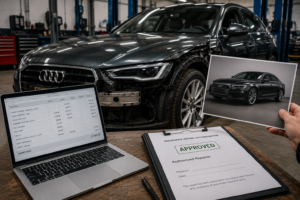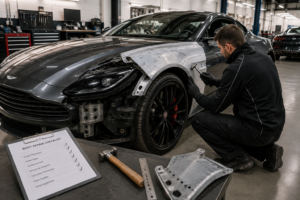
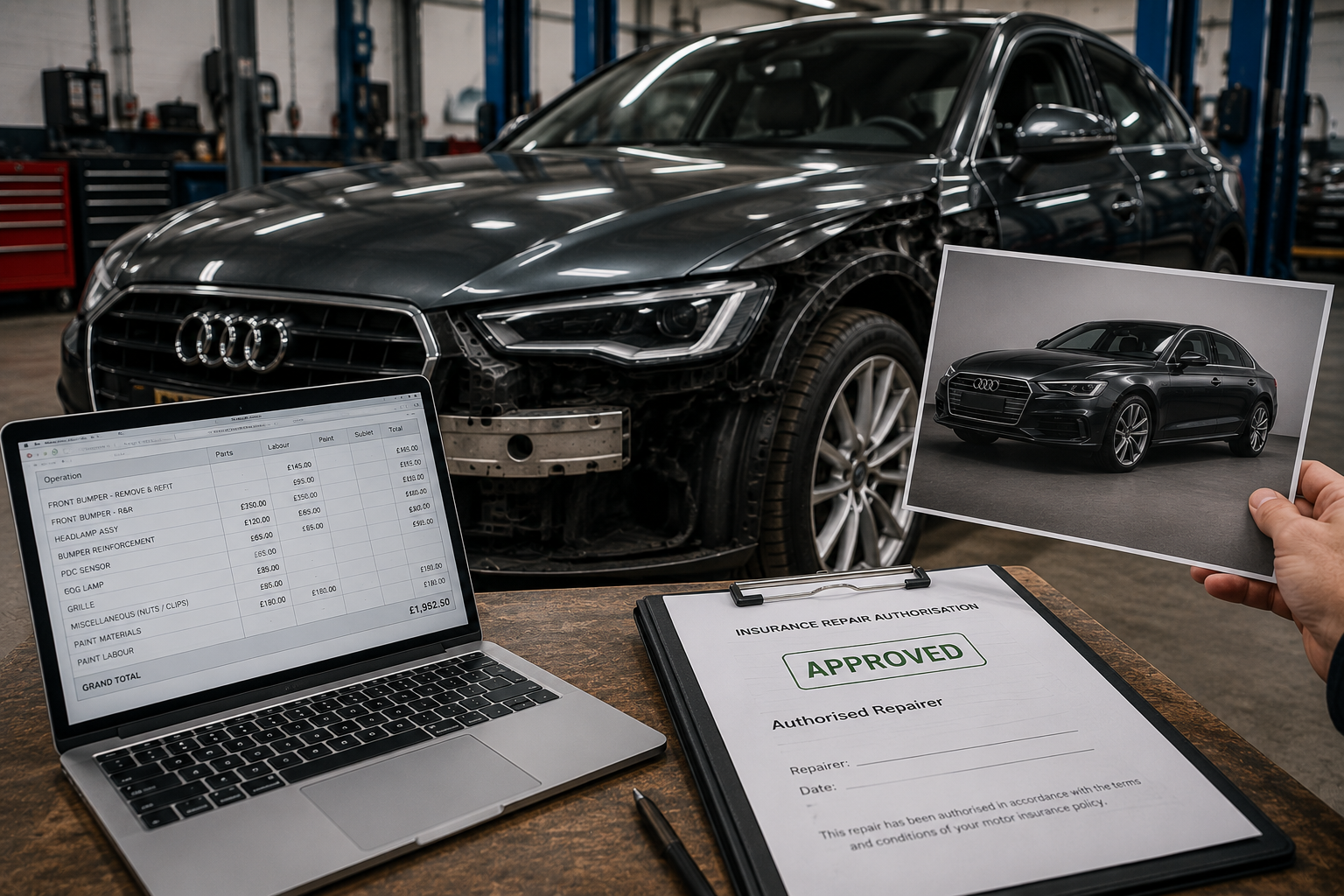
After a crash, your insurer will usually put you through to a recommended repairer within days, sometimes hours, of your call. That recommendation protects their costs and their claims-handling targets — not necessarily the bodywork, the electronics, or the resale value of your Aston Martin, Bentley, Porsche, or Range Rover.
An insurance-approved repairer is a bodyshop with a commercial contract with an insurer, agreeing to fixed labour rates and turnaround targets in exchange for referred work. Approval reflects a pricing arrangement, not a guarantee of marque-specific expertise, genuine parts, or manufacturer-approved ADAS recalibration — all of which matter more on a prestige vehicle than on a mainstream one.
If your car is a daily-driver hatchback, that arrangement usually works fine. If it’s a car with aluminium panels, adaptive suspension, or a windscreen full of cameras and radar sensors, the gap between “approved” and “right for this car” can be significant.
What Does “Insurance-Approved Repairer” Actually Mean?
An approved repairer network is a group of bodyshops that insurers refer work to under a service-level agreement. In return for guaranteed volume, the repairer accepts negotiated labour rates, agreed parts margins, and targets for how quickly a car moves through the workshop.
None of this is secret or sinister — it’s how most UK motor claims are processed, and it keeps premiums down across the market. The issue for prestige car owners is that the same network handling a supermini’s rear bumper is often handling your car’s structural repair and ADAS recalibration under the same commercial terms.
Approval is granted by the insurer, not by Aston Martin, Bentley, Porsche, or any other manufacturer. A repairer can be fully “insurance-approved” while holding no manufacturer accreditation at all for the marque sitting on its ramp.
Why “Approved” Doesn’t Guarantee the Best Repair for a Prestige Car
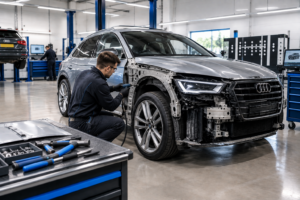
Volume-focused networks are built around throughput. Fixed turnaround targets and negotiated labour rates work well for standard repairs, but they leave little room for the extra time a prestige repair genuinely needs — additional diagnostic checks, careful panel alignment on lightweight alloy or carbon-composite body sections, and full recalibration of driver-assistance systems.
Genuine Parts vs “Will-Fit” Alternatives
Approved networks are often incentivised to specify non-genuine or “will-fit” parts to protect their margin under the contracted rates. On a mainstream car this might be invisible. On a prestige vehicle, a non-genuine bumper skin, sensor bracket, or crash structure component can affect fit, finish, and — more importantly — the accuracy of the ADAS systems mounted to it.
ADAS Recalibration and Ride-Height-Sensitive Systems
Prestige cars increasingly rely on cameras and radar behind the windscreen, in the bumpers, and around the wheel arches for adaptive cruise control, lane-keep assist, and automatic emergency braking. These systems need precise recalibration after almost any impact, and some require it after glass replacement or even a wheel alignment. A repairer without the manufacturer-specific calibration equipment for your marque may sub-contract this step, extend your repair time, or — worse — skip a calibration that isn’t visibly obvious but affects how the car behaves at speed.
Paint Matching and Bespoke Finishes
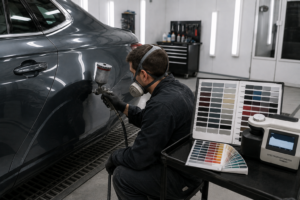
Prestige marques offer paint finishes — deep metallics, satin wraps, multi-stage pearls — that are harder to match than standard solid colours. A generalist bodyshop working to a fixed labour rate has less incentive to spend the extra hours blending a repair into an adjacent panel invisibly. On a car bought partly for how it looks, a slightly-off panel match is a defect you’ll notice every time you park it.
Do You Have to Use Your Insurer’s Approved Repairer?
No. You have the right to choose who repairs your car, whether you’re claiming through your own insurer or through a third party’s insurer following a non-fault accident. Insurers can recommend their network, and will often make it the path of least resistance, but they cannot force you to use it.
In practice, insurers may apply some friction to that choice — asking you to pay your excess upfront, or setting different terms around any repair guarantee if you go outside their network. [VERIFY: current ABI/FCA wording on insurer obligations and any excess or guarantee differences, to quote precisely and accurately]. It’s worth asking your insurer directly, in writing, what changes if you choose your own repairer, so you know exactly where you stand before you agree to anything.
How Do You Choose the Right Repairer for a Prestige Car After an Accident?
Start with accreditation that speaks to the actual repair, not just the insurance relationship. BSI-approved bodyshop status (to the relevant British Standard for vehicle damage repair) signals independently assessed process and quality control, regardless of which insurer’s network the shop sits in.
This matters more for a fault or non-fault claim on a prestige vehicle than most owners realise, because the cost of getting it wrong isn’t just a respray you’re unhappy with — it can affect resale value, warranty standing, and the safe operation of driver-assistance systems. A few targeted questions upfront tell you quickly whether a repairer is set up for your marque or simply processing it through a generic system.
Ask direct questions before you commit to any repairer, approved or not:
- Do your technicians hold marque-specific training for my car’s manufacturer?
- Is ADAS recalibration carried out in-house, and to manufacturer specification?
- Do you fit genuine parts as standard, and will you tell me if a will-fit alternative is proposed?
- Can I see evidence of your BSI approval or other independent accreditation?
- Will you deal directly with my insurer, including any non-fault claim, on my behalf?
A repairer confident in its own standards will answer these without hesitation. One that can’t, or won’t, is telling you something too.
What This Means for Prestige Car Owners in Cheshire
Crash Specialist Garage is a BSI-approved prestige accident-repair bodyshop in Macclesfield, working across fifteen marques including Aston Martin, Bentley, Porsche, Range Rover, and Tesla. The workshop is set up around marque-specific repair standards rather than a single generic process, which matters when the car in the bay has aluminium body panels one week and a full ADAS sensor suite the next.
Crash Specialist Garage also handles insurance claims and non-fault claims directly, so choosing an independent, marque-specialist repairer doesn’t mean navigating the insurance side alone. The point isn’t that every approved repairer does a poor job — many are perfectly competent. It’s that “approved” is a commercial status, and on a car like yours, it’s worth checking that commercial status lines up with the technical standard the repair actually needs.
Making the Right Call After an Accident
Nobody plans for a bodyshop after an accident — you’re dealing with the shock of the crash, the insurance call, and a car you need back on the road. That’s exactly the moment insurers count on you taking the path of least resistance into their network.
Taking an extra day to check a repairer’s accreditation, marque experience, and ADAS capability costs you very little against the months, or years, you’ll spend driving the car afterwards. For a prestige vehicle, that check is the difference between a repair that’s merely completed and one that’s completed properly.
If you’ve had a fault or non-fault accident and you’re being steered toward an approved repairer network, get a second opinion before you commit. Contact Crash Specialist Garage in Macclesfield for an assessment and quote — we’ll look at the damage, talk you through your options, and handle the insurance conversation if you decide to bring the car to us.
Frequently Asked Questions
Can I choose my own repairer instead of my insurer’s approved garage?
Yes. You have the legal right to choose which repairer fixes your car, whether the claim is through your own insurer or a third party’s insurer after a non-fault accident. Insurers can recommend their approved network, but they cannot force you to use it.
Will using a non-approved repairer affect my claim or void my warranty?
Using an independent repairer doesn’t affect your right to claim, though your insurer may handle payment or excess slightly differently outside its network — always confirm this in writing before you proceed. Your manufacturer’s warranty is separate from your insurance claim and isn’t voided by choosing a repairer outside the insurer’s network, provided genuine parts and correct procedures are used.
What’s the difference between an “insurance-approved” repairer and a “manufacturer-approved” repairer?
An insurance-approved repairer has a commercial contract with an insurer covering rates and referred volume. A manufacturer-approved repairer has been independently assessed by the car maker against its specific tooling, training, and repair-procedure requirements — a repairer can hold one, both, or neither status.
Does it cost more to use my own repairer instead of the insurer’s network?
Not necessarily, though some insurers may ask you to pay your excess upfront if you go outside their network, reclaiming it later if the claim is non-fault. It’s worth asking your insurer to confirm exactly what changes, if anything, before you decide.
What should I check before agreeing to have my prestige car repaired?
Check for BSI or equivalent independent accreditation, marque-specific technician training, in-house ADAS recalibration to manufacturer specification, and a clear answer on whether genuine parts are used as standard. A repairer confident in its standards will answer all of these directly.
Does Crash Specialist Garage deal directly with insurers?
Yes. Crash Specialist Garage manages insurance claims, including non-fault claims, directly with insurers, so choosing an independent marque-specialist repairer doesn’t mean handling the insurance process alone.