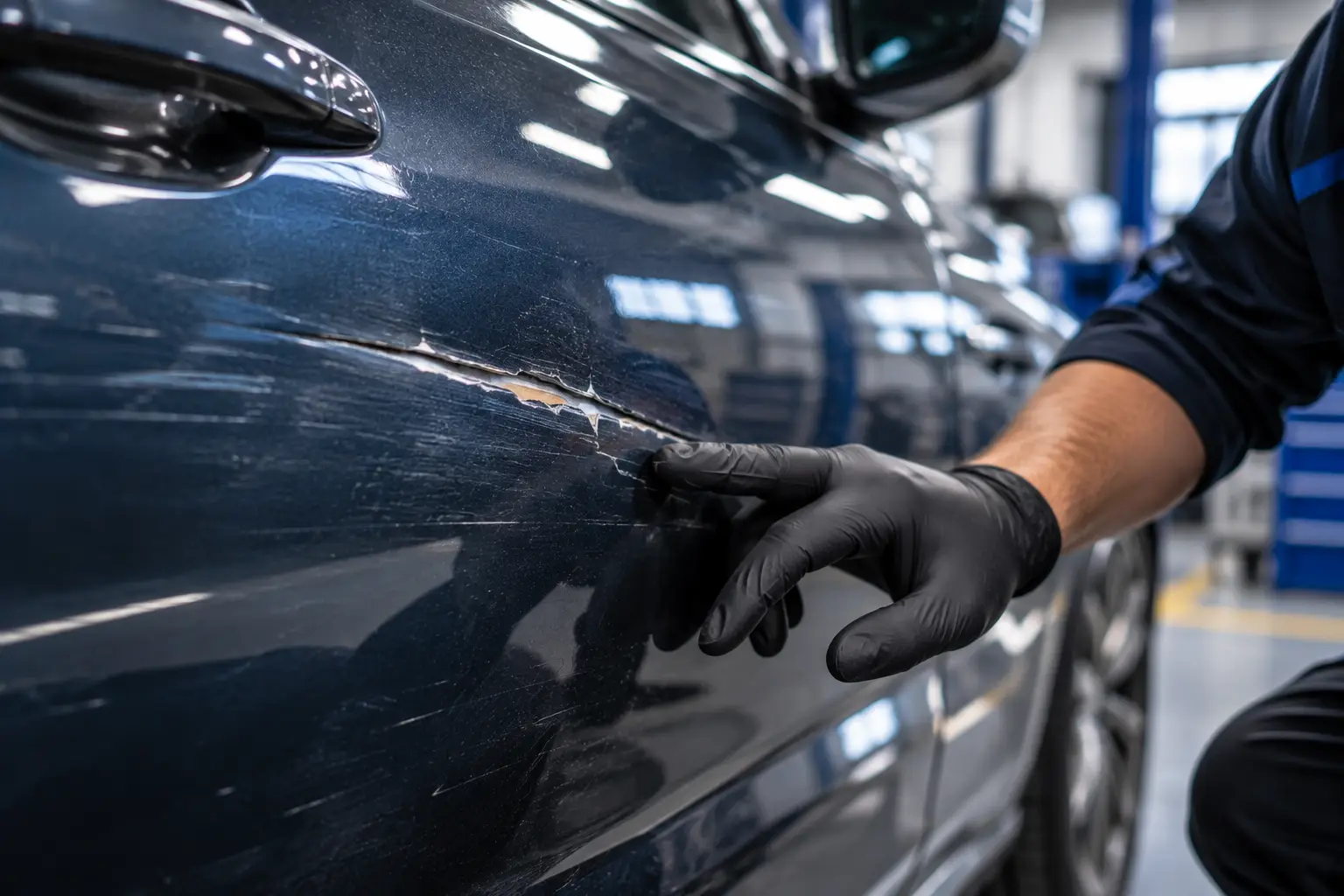
You’ve found it: a long, sharp line along a door or wing that wasn’t there yesterday. The first question most owners ask is whether it can simply be polished away.
A deep scratch can only be buffed out if it sits within the clear coat, the transparent top layer of paint. If the scratch has gone through to the coloured base coat, primer or bare metal, buffing can’t remove it — the area needs filling, refinishing and usually blending to restore both appearance and protection.
The difficulty is that “deep” means different things to different people. A scratch that looks dramatic can sometimes be polished out, while one that seems minor may have cut right through to the metal. Here’s how to tell the difference, and what each type of repair involves.
What Are the Layers of Car Paint?
To understand what can and can’t be buffed out, it helps to know what a scratch is cutting through. Factory paint on a modern car is built up in layers, each with its own job:
- Clear coat — the transparent top layer that gives gloss and protects the colour beneath from UV light, weather and minor abrasion
- Base coat — the coloured layer that gives the car its paint colour, including any metallic or pearl effects
- Primer — the layer that helps the base coat bond to the body and adds corrosion protection
- Metal or composite — the panel itself, which may be steel, aluminium or plastic depending on where it is on the car
Altogether, those paint layers are remarkably thin — far thinner than most people assume. That’s why a scratch that only feels shallow can still have breached the clear coat.
How Can You Tell How Deep a Scratch Is?
You can get a reasonable first indication yourself, but a definite answer needs a closer look under proper lighting.
The Fingernail Test
Clean the area gently, then run a fingernail lightly across the scratch (not along it). If your nail glides over without catching, the scratch is likely confined to the clear coat. If your nail catches in the groove, it has probably gone deeper.
It’s a rough guide, not a diagnosis. Some clear coat scratches catch a nail; some deeper ones are narrow enough not to.
Look at the Colour Inside the Scratch
- Same colour as the car, just lighter or hazy — likely a clear coat scratch
- Colour visible but the scratch looks flat and dull — may have reached the base coat
- White, grey or a contrasting colour — usually primer showing through
- Silver or bright metal — the scratch has reached the panel itself
- Orange or brown tinge — the bare metal has started to corrode
Wet the Surface
Wipe the scratch with a little clean water. If it virtually disappears while wet, it’s likely in the clear coat, where polishing may help. If it stays clearly visible, it’s probably deeper.
When Can a Scratch Be Buffed Out?
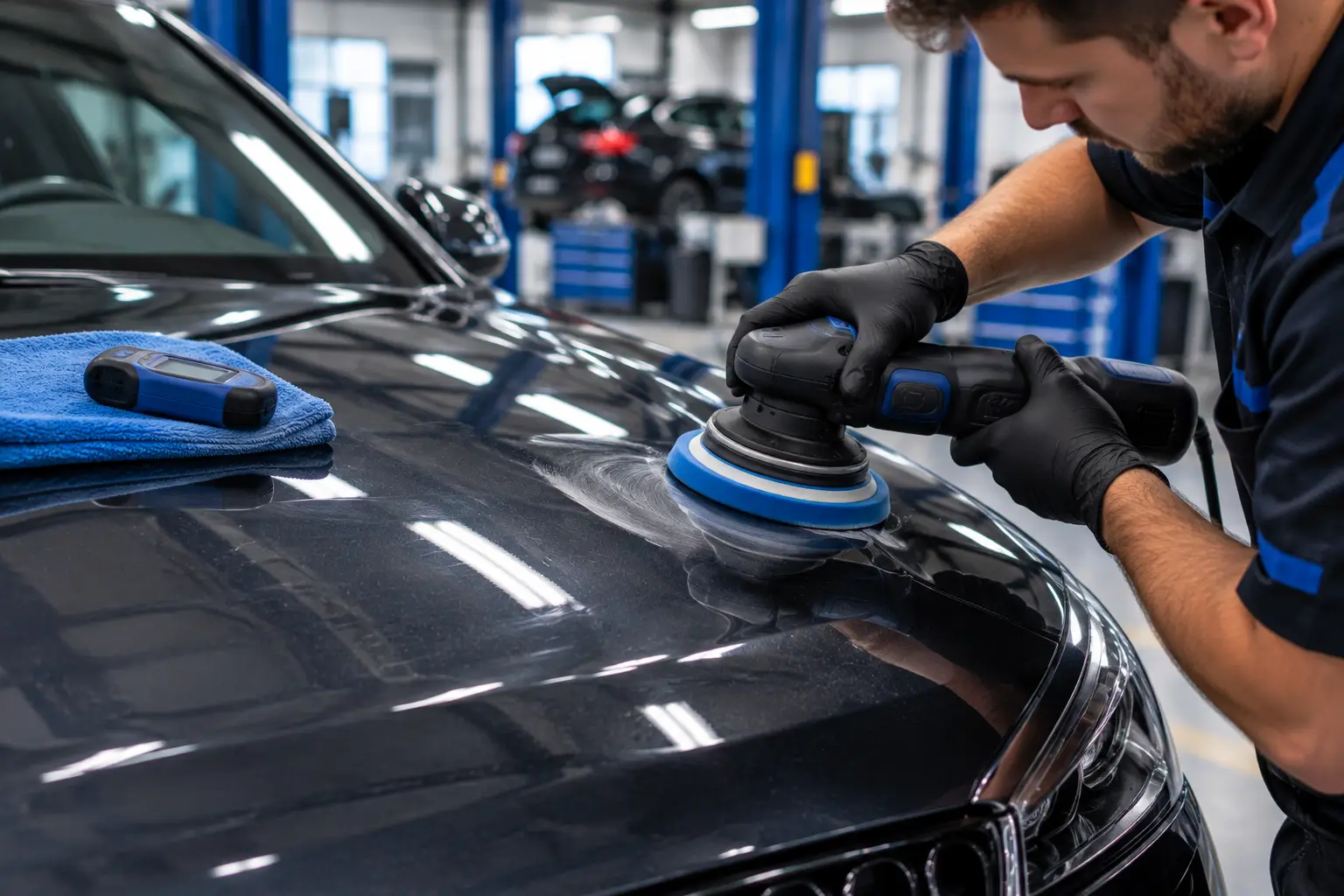
Scratches that sit entirely within the clear coat are the ones polishing can deal with. Machine polishing removes a tiny amount of clear coat around the scratch, levelling the surface so light reflects evenly again and the line disappears.
This is skilled work. Clear coat is finite: polish too aggressively, or too often over the years, and you can thin it to the point where it no longer protects the colour beneath. A good technician measures paint thickness before and during polishing so they know how much material is available to work with.
Light marks from car washes, brushing past hedges or careless loading in a car park often fall into this category.
When Does a Scratch Need Repainting?
Once a scratch goes through the clear coat into the base coat or beyond, no amount of buffing will make it disappear. Polishing can soften the edges, but the colour loss underneath remains visible — and you’ll have removed clear coat in the process.
At that point, the area needs to be properly refinished. That typically involves:
- Cleaning and assessing the full extent of the damage
- Treating any corrosion if bare metal has been exposed
- Filling and flatting the scratch so the surface is perfectly level
- Priming the repair area
- Applying matched base coat in the car’s exact colour
- Applying clear coat, often blended into the surrounding paint so the repair can’t be seen
Depending on the location, length and depth, that might be a localised repair or a full panel refinish.
Can a Touch-Up Pen Fix a Deep Scratch?
Touch-up paint can be useful as a temporary measure on small stone chips, mainly to keep moisture away from bare metal. On a long or deep scratch, though, it rarely gives a satisfactory finish. The paint sits in the groove at an uneven height, it won’t match the gloss or depth of factory clear coat, and on metallic or pearlescent colours the effect is often obvious.
If the scratch has reached the metal, sealing it promptly is more important than making it invisible straight away. Exposed steel can begin to corrode surprisingly quickly in a British winter, and rust spreading under the surrounding paint turns a simple repair into a larger one.
Do Scratches on Prestige Cars Need Different Treatment?
The principles are the same, but the margin for error is smaller. Prestige cars often have:
- Multi-stage paints such as tri-coat pearls, which are harder to colour-match
- Thinner factory clear coat on some models, limiting how much polishing is safe
- Matte or satin finishes, which can’t be polished at all
- Aluminium panels, which corrode differently from steel and need specific treatment if exposed
On a high-value car, a visible patch or a colour mismatch can affect resale value more than the original scratch would have. That’s a strong argument for having a deep scratch assessed professionally rather than attempting a DIY fix first.
Why Do Scratches Look Worse on Some Colours?
Dark colours, particularly black and deep blue, show scratches far more clearly than silver or white, because the lighter primer or bare metal beneath creates stronger contrast. Light reflecting from a dark, glossy surface also highlights fine swirl marks and edges.
Metallic and pearlescent paints add another layer of difficulty. The flakes in the base coat sit at particular angles to create the effect, and a repair has to reproduce that orientation as well as the colour. Get it wrong and the repaired area can look right from one angle but darker or lighter from another — which is why blending into adjacent paint is so often part of a proper repair.
Should You Claim on Insurance for a Deep Scratch?
For a single scratch, many owners choose to pay privately rather than risk an increase in their premium or losing a no-claims discount. For more extensive damage — vandalism along several panels, for example — a claim may make more sense.
It’s worth getting an assessment and a written quote before deciding. That gives you the facts to weigh the repair cost against your excess and the likely effect on future premiums.
FAQ
Can a deep scratch be buffed out?
Only if the scratch is confined to the clear coat, the transparent top layer of paint. If it has gone through to the coloured base coat, primer or bare metal, buffing cannot remove it and the area needs to be filled, refinished and blended.
How do I know if a scratch has gone through the clear coat?
Run a fingernail across the scratch. If it catches, the scratch has probably gone deeper than the clear coat. White, grey or silver showing inside the scratch also indicates primer or bare metal, which means polishing alone will not fix it.
Is it safe to leave a scratch that has reached bare metal?
It is best not to leave it. Exposed metal can begin to corrode, especially in wet or salted winter conditions, and rust can spread under the surrounding paint, making a later repair larger and more expensive.
Will a touch-up pen fix a deep scratch?
A touch-up pen can seal a small chip temporarily, but it rarely gives an invisible finish on a long or deep scratch. It cannot reproduce the depth and gloss of factory clear coat, particularly on metallic or pearlescent colours.
Can Crash Specialist Garage assess a scratch on my car?
Yes. Crash Specialist Garage is a BSI-approved bodyshop in Macclesfield repairing 15 marques, from Aston Martin and Porsche to Ford and Kia. The team can assess the depth of the scratch and advise whether polishing or refinishing is the right repair.
Get the Depth Right Before Choosing the Fix
The right repair for a scratch depends entirely on how deep it goes. Clear coat scratches can often be polished away; anything deeper needs proper refinishing to restore both the look and the protection of the paint.
If you’re not sure which you’re dealing with, contact Crash Specialist Garage in Macclesfield for an assessment before the scratch has a chance to get worse.