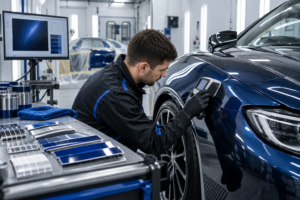
If your car has just been in a collision and someone has mentioned “ADAS calibration,” it helps to first understand what ADAS actually is. It isn’t one component, it’s a network of cameras, radar units and sensors working together in real time.
A modern ADAS system combines a forward-facing camera, radar sensors, and ultrasonic parking sensors, each reading the road in a different way and feeding data to a central control unit. That unit fuses the inputs to power features like lane-keep assist, adaptive cruise control, automatic emergency braking and parking assistance. If any one sensor is misaligned, even slightly, the whole system’s accuracy is compromised.
What Is ADAS and What Does It Actually Do?
ADAS stands for Advanced Driver Assistance Systems, the collective term for the safety technology built into most cars produced over the last several years. It covers features drivers now take for granted: lane-keep assist that nudges the wheel back if you drift, adaptive cruise control that holds a set distance from the car in front, automatic emergency braking that reacts faster than a human can, and parking sensors that judge distance to a kerb or a wall.
None of these features work in isolation. Each one depends on a small set of sensors constantly reading the world around the car and a control unit that interprets that data and decides what, if anything, needs to happen next. On a prestige vehicle, that sensor array is often more extensive than on a mainstream car, and it is usually built more tightly into the bodywork, behind badges, in bumpers, and around the windscreen.
How Does the Forward Camera Work in an ADAS System?
The forward-facing camera, typically mounted at the top of the windscreen behind the rear-view mirror, is the system’s main set of eyes. It reads lane markings, road signs, traffic signals and the outline of other vehicles and pedestrians ahead.
This camera is what makes lane-keep assist and lane departure warning possible. It tracks the white lines either side of the car and, working with the steering system, corrects course if the car starts to drift without an indicator being used. It also plays a supporting role in automatic emergency braking, helping the system distinguish between a stationary object, a moving vehicle and a pedestrian stepping into the road.
Because the camera relies entirely on what it can see, its exact position and angle matter enormously. A camera pointed even a fraction of a degree off its calibrated position will misjudge where the lane actually is, which is precisely why windscreen replacement or any bodywork near the camera mount triggers a recalibration requirement.
What Role Does Radar Play in Adaptive Cruise Control and Automatic Braking?
Where the camera sees, radar measures. Radar sensors, usually mounted behind the front bumper and sometimes in the rear bumper too, send out radio waves and measure how long they take to bounce back off objects ahead. That tells the car two things a camera alone struggles with: exact distance and closing speed.
This is the technology behind adaptive cruise control. The radar continuously tracks the vehicle in front and adjusts your speed to maintain a set following distance, slowing and accelerating without driver input. It also underpins automatic emergency braking on many vehicles, working alongside the camera to confirm that an object ahead is real, is in the car’s path, and is closing fast enough to warrant intervention.
Radar performs well in conditions where cameras struggle, poor light, fog, heavy rain, because it isn’t reliant on visible light to work. That’s exactly why it’s paired with a camera rather than used alone: each sensor covers the other’s weak points.
What About Ultrasonic Parking Sensors and Lidar?
Ultrasonic sensors, the small round discs visible in most front and rear bumpers, use sound waves rather than light or radio waves. They’re built for short range, typically a few metres at most, which makes them well suited to low-speed manoeuvres like parking, where the car needs to judge distance to a kerb, a wall or another vehicle in tight quarters.
Some higher-end and newer vehicles also carry lidar, which uses laser pulses to build a more detailed, three-dimensional picture of the car’s surroundings than radar alone can achieve. Lidar isn’t yet standard across every marque or model, but where it’s fitted, it adds another layer of precision to the sensor fusion process, particularly for advanced driver assistance and semi-autonomous features.
Every one of these sensors, camera, radar, ultrasonic, lidar, is fitted at a precise location and angle set by the manufacturer. That positioning isn’t a rough guide, it’s calibrated to a tolerance the car’s software expects, and it’s exactly what a collision can disturb.
How Do These Systems Work Together?
None of these components do anything useful on their own. Each sensor feeds its data into a central control unit, and the car’s software fuses those separate readings into a single, coherent picture of what’s happening around the vehicle. This is often called sensor fusion, and it’s the part of ADAS that does the actual thinking.
If the camera reports a vehicle ahead and the radar confirms its distance and closing speed, the system can act with confidence, applying the brakes or adjusting cruise control speed as needed. If the inputs disagree, say the camera’s alignment is off and it’s reporting a lane position that doesn’t match what the radar and the car’s actual GPS position suggest, the system either behaves erratically or, more likely on a well-designed car, disables the affected feature and warns the driver.
That’s the mechanism worth understanding before anyone talks about calibration: ADAS isn’t one sensor doing one job. It’s several sensors, each calibrated to an exact position, agreeing with each other continuously, dozens of times a second.
Why Can a Minor Collision Knock ADAS Out of Alignment?
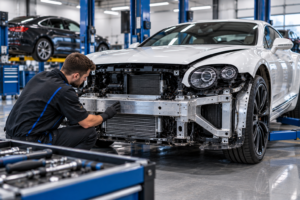
It doesn’t take a serious impact to disturb an ADAS sensor’s calibration. A bumper knock in a car park, a low-speed shunt, even a windscreen chip that needs the glass replacing, can all shift a camera or radar unit by a small enough amount to matter, without leaving any obvious sign of damage.
This is the part prestige car owners often find hardest to accept: the car can look completely fine, drive completely fine at first glance, and still have a sensor reading a few degrees off where it should be. Bumpers house radar units and ultrasonic sensors; windscreens carry the forward camera. Both are exactly the components that get touched during even minor bodywork repair, whether or not the sensor itself was struck directly.
Structural work makes this more pronounced. If a bumper is removed and refitted, or a windscreen is replaced, the sensor behind it has been physically moved and reseated, even if the part itself is undamaged and goes back in what looks like exactly the same position. Manufacturers don’t leave that to chance, which is why calibration is built into their official repair procedures for this kind of work, not treated as an optional extra.
Why Is ADAS Calibration Not Optional After a Repair?
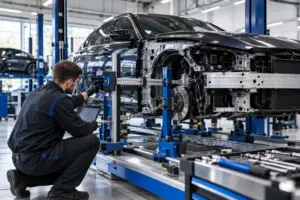
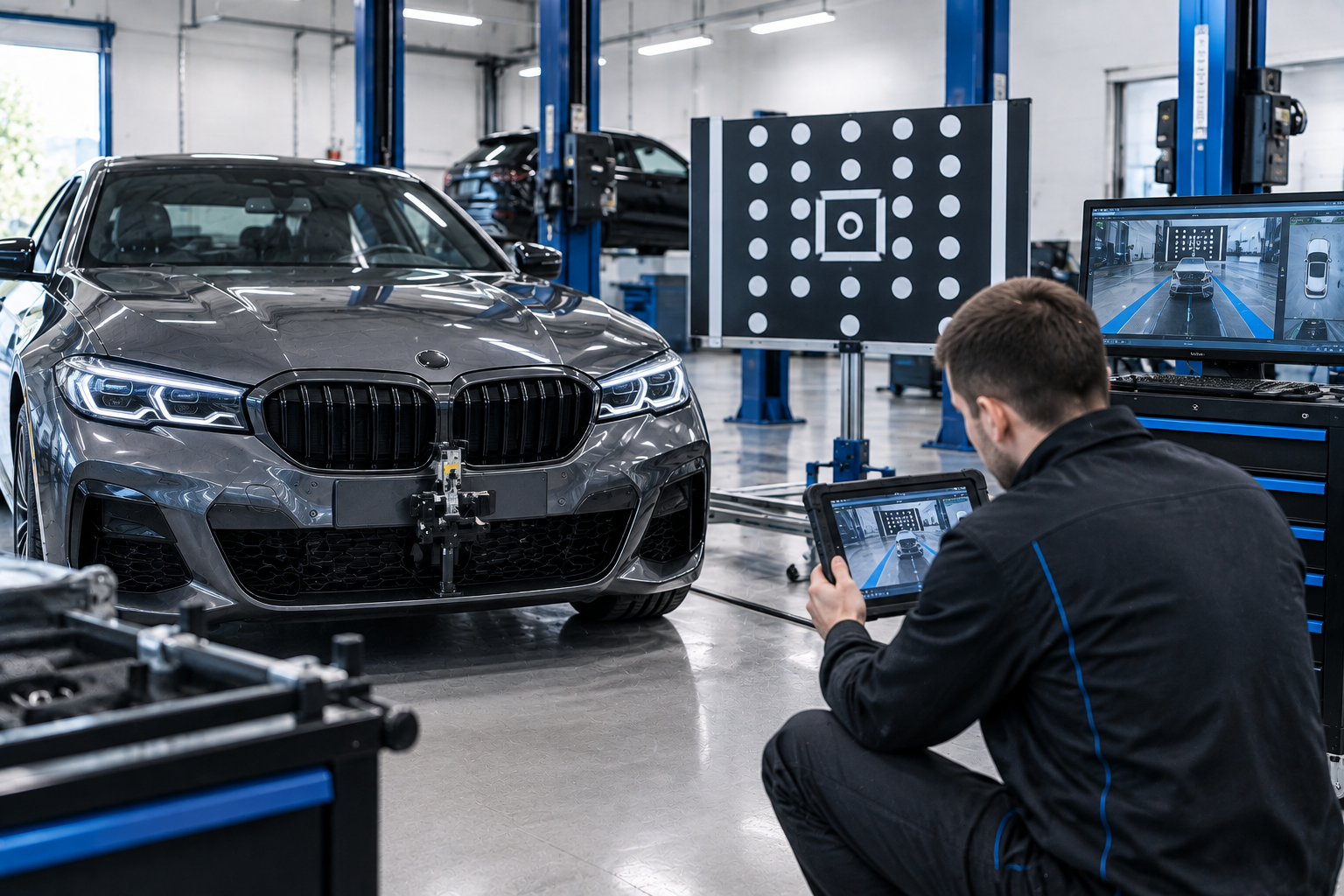
Recalibration resets each sensor to the manufacturer’s specified position and tolerance, confirmed against target boards and reference points using dedicated calibration equipment, not by eye and not by clearing a warning light on the dashboard. Static calibration is carried out in a controlled workshop environment with the car stationary; dynamic calibration involves driving the car under specific conditions so the system can recalibrate itself against real road data. Many vehicles need both.
Skipping this step, or having it done without the correct manufacturer targets and software, doesn’t necessarily throw an obvious fault. The car may drive normally for weeks. But a camera or radar unit reading even slightly out of true means lane-keep assist can misjudge where the lane actually is, automatic emergency braking can react late or not at all, and adaptive cruise control can misread the distance to the car in front. These are safety systems built around split-second, millimetre-level accuracy, so a small calibration error is not a small problem.
This is why a proper accident repair bodyshop treats ADAS calibration as a mandatory step in the repair process, not an add-on the customer has to arrange separately. On a prestige vehicle with an extensive sensor array, that means using the manufacturer’s own calibration targets and software, not a generic aftermarket workaround, and confirming the work in writing before the car goes back on the road.
Frequently Asked Questions
What does ADAS stand for?
ADAS stands for Advanced Driver Assistance Systems, the umbrella term for safety technology such as lane-keep assist, adaptive cruise control, automatic emergency braking and parking sensors, all powered by cameras, radar and other sensors working together.
Can a minor bumper knock really affect my car’s ADAS system?
Yes. Radar units and ultrasonic sensors are commonly mounted in the front and rear bumpers, and a low-speed knock can shift their alignment even when there’s no visible damage to the bumper itself.
Do I need ADAS calibration after a windscreen replacement?
In most cases, yes. The forward-facing camera that powers lane-keep assist and supports automatic emergency braking is typically mounted on the windscreen, so replacing the glass moves the camera and requires recalibration to the manufacturer’s specification.
What’s the difference between static and dynamic ADAS calibration?
Static calibration is carried out with the car stationary in a workshop, using target boards and reference points set at precise distances. Dynamic calibration involves driving the car under specific conditions so the system can recalibrate against live road data. Many vehicles require both.
How do I know if my ADAS sensors are out of calibration?
Not always by an obvious warning. A car can drive normally with a sensor slightly out of true, which is exactly why calibration is treated as a mandatory step after any repair that disturbs a bumper, windscreen or panel near a sensor, rather than something to wait and see about.
Will my insurer cover ADAS calibration as part of a repair claim?
Calibration is a manufacturer-specified part of returning a vehicle to pre-accident condition after relevant bodywork, so a properly handled claim should include it. [VERIFY: current insurer policy wording on ADAS calibration as a standard claim inclusion, in case this needs confirming per insurer.]
Conclusion
Understanding how cameras, radar and sensors work together makes it easier to see why ADAS calibration after a collision isn’t an upsell, it’s how the manufacturer’s safety systems get put back to the standard they were designed to meet. Crash Specialist Garage carries out ADAS calibration in-house as a standard part of accident repair, using manufacturer targets and software across all 15 marques it works with. If your car has been in a collision and you want to understand what your repair should include, get in touch for an assessment.