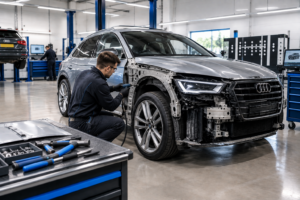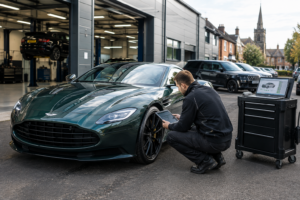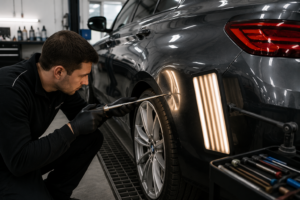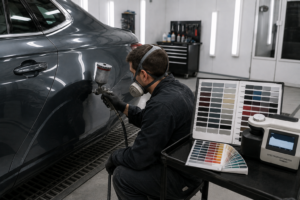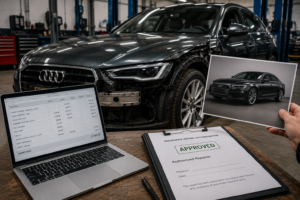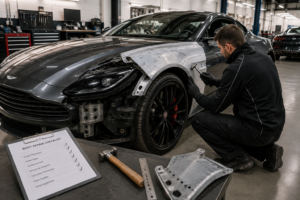
You’ve had the dent knocked out, the panel resprayed, and the car booked back for collection — but the question that actually keeps owners awake is simpler: will it look like it was never touched at all?
Paint matching after a repair combines the car’s factory colour code, a spectrophotometer reading of the actual panel, and a hand-mixed test spray, because even identical paint codes shift with age, UV exposure and batch variation. A skilled technician then blends the new paint into the surrounding panels so the transition disappears under every type of light.
Why Is Paint Matching Harder on Prestige and Luxury Cars?
Every car leaves the factory with a paint code, but that code is a starting point, not a finished answer. Prestige marques use multi-stage finishes — a base coat, a mica or pearl layer, then lacquer. Metallic and pearlescent finishes are the biggest challenge, since flake size, orientation and density all affect how a colour reflects light. Age and a car’s individual history add further variation.
What Actually Happens During Paint Matching After a Repair?
Reading the colour, not just the code
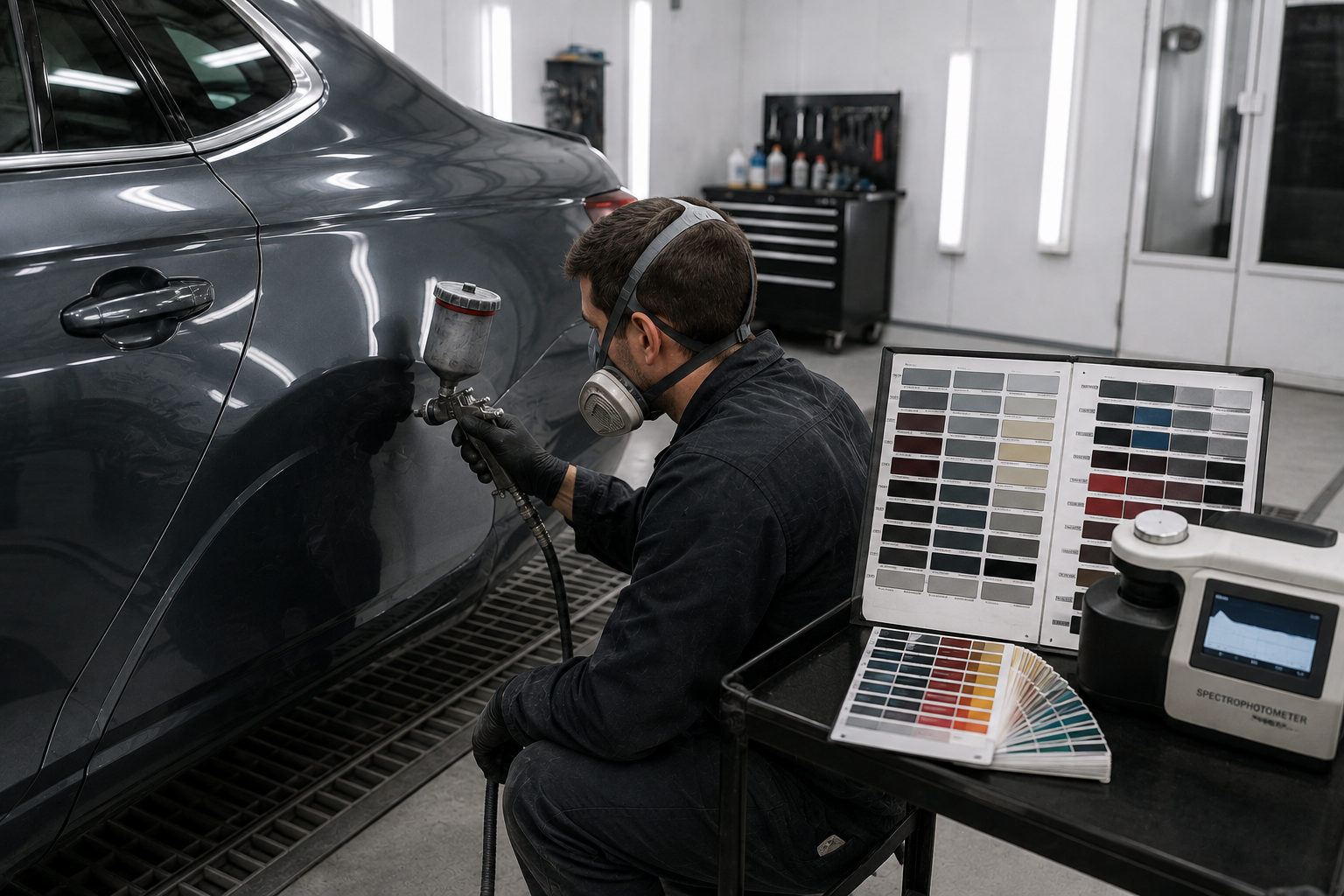
The technician starts with the manufacturer’s paint code, then takes a spectrophotometer reading directly from an undamaged panel on the car.
Mixing and test spraying
The reading feeds into computerised paint-mixing software, which calculates a formula adjusted specifically for this car. A test spray is checked in daylight, workshop lighting and sometimes outdoors.
The right environment: why the booth matters
A controlled paint booth keeps temperature, airflow and dust to a consistent standard, which affects how paint cures and reads once dry.
Blending into adjoining panels
Technicians typically blend the new colour into the neighbouring panels, softening any microscopic difference in tone so there’s no visible line where old paint meets new.
Clear coat and final finish
The final clear lacquer is applied and flatted to match the surrounding panels’ gloss level and texture.
Why Do Two Cars in the “Same” Colour Still Look Different?
Paint is mixed in production runs, and even cars that left the factory a few months apart can carry slightly different pigment ratios. A spectrophotometer reading of your car, not a generic swatch book, is the only reliable starting point for accurate paint matching.
What Happens If the Paint Match Isn’t Right?
Under most insurance repair guarantees and consumer rights law, you’re entitled to a repair that restores your car to its pre-accident condition. A BSI-approved bodyshop working to PAS 125 applies the same documented paint process on every repair.
Does Paint Matching Take Longer on ADAS-Equipped or Modern Prestige Models?
Not usually — paint matching is a separate process from ADAS calibration, though a repaired panel housing a sensor bracket will need recalibrating after painting, adding a distinct stage to the timeline.
Getting a Seamless Repair, Not Just a Close Match
If you’d like an assessment of your car or a quote for a repair, get in touch with Crash Specialist Garage in Macclesfield. We’re happy to talk through exactly how we’d approach the colour match on your specific vehicle before any work begins.
Frequently Asked Questions
How long does paint matching after a repair usually take?
Paint matching itself typically adds a small amount of time to the overall repair rather than extending it significantly, since it happens alongside panel preparation.
Can you match paint on a car that’s been resprayed before?
Yes, though it requires extra care, because a previous repair may already have introduced a slight variation from the factory finish.
Will the repaired panel ever look slightly different in certain light?
On a correctly matched and blended repair, no — the aim is a match that holds up in direct sunlight, overcast daylight and artificial lighting alike.
Does my insurer control which paint process is used for my repair?
Your insurer can recommend a repairer, but you’re entitled to choose your own bodyshop, and the quality of the repair should meet the same standard regardless of who arranges it.
Is metallic or pearlescent paint always harder to match than solid colours?
Generally, yes, because metallic flake and pearl layers depend on spray technique, angle and thickness in a way solid colours don’t.
What should I ask a bodyshop before booking a repair on my car?
Ask whether they use a spectrophotometer, whether they blend paint into adjoining panels, and whether they’re BSI-approved to PAS 125.