A repaired panel that doesn’t quite match is one of the most common worries prestige car owners raise before an accident repair even begins — and it’s usually most visible in direct sunlight, exactly where a paint mismatch has nowhere to hide.
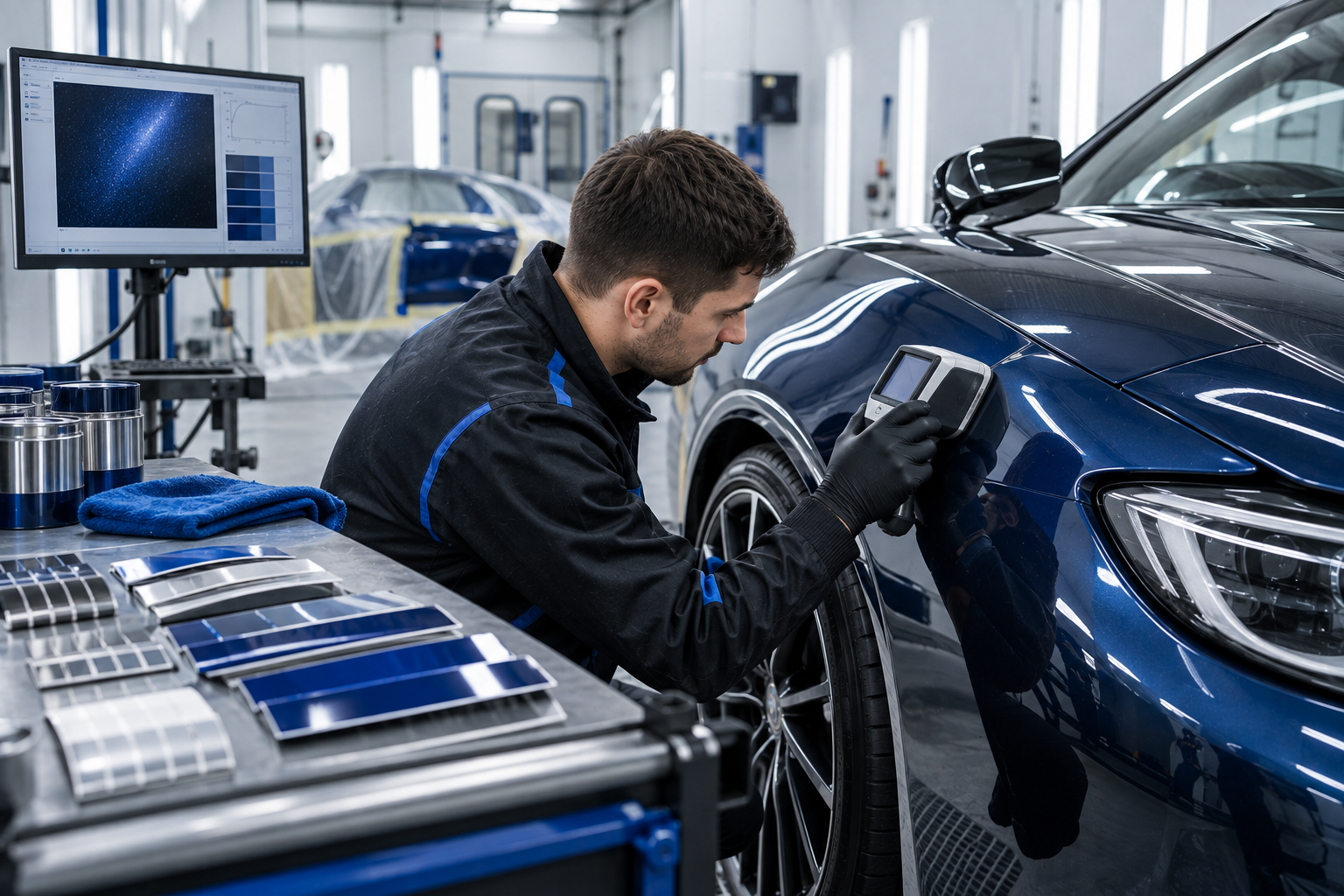
Paint matching after a repair starts with a spectrophotometer reading of your car’s actual colour, not just its factory code, because paint fades, batches vary, and metallic flake settles differently on every panel. On prestige cars with pearlescent or multi-stage finishes, that reading is combined with careful blending into the adjacent panel so the repair disappears rather than merely matches.
Why Is Paint Matching So Difficult on Prestige Cars?
Every car leaves the factory with a paint code, but that code is only ever a starting point. The exact shade on your bonnet today has been shaped by years of UV exposure, temperature cycling, and whatever the elements have thrown at it since the day it was built, so the paint code alone rarely produces an exact match years later.
Prestige marques make this harder still. Where a mainstream hatchback might offer a dozen solid colours, brands like Aston Martin, Porsche and Bentley run complex metallic, pearlescent and multi-stage finishes, sometimes with bespoke or low-volume colours that were only ever applied to a handful of cars. Batch-to-batch variation in the original paint, even from the manufacturer itself, means two cars that left the factory in the same colour can already read slightly differently side by side.
Metallic and pearlescent finishes add a further layer of complexity because they aren’t a single flat colour at all. They contain aluminium or mica flake suspended in the paint, and how that flake catches the light depends on its orientation, density and the angle it’s sprayed at. Get the spray technique even slightly wrong and the colour can look correct under workshop lighting, then shift visibly once the car is back outside.
How Does a Spectrophotometer Read Your Car’s Actual Colour?
A spectrophotometer measures the precise wavelengths of light reflected off your car’s existing paint, rather than relying on the manufacturer’s original colour code as a guess. It reads the panel at multiple angles, because metallic and pearlescent paints behave differently depending on the viewing angle, a property paint technicians call flop.
That reading is then cross-referenced against the manufacturer’s formula and adjusted for how the paint on your specific car has aged. The output isn’t the factory formula lifted straight from a database; it’s a tinted, custom-blended match calculated for the exact panel being repaired, on that specific car, on that day.
This step matters most on cars where the badge on the boot doesn’t tell you enough about the paint inside it. A prestige marque’s badge covers a huge range of finishes, from solid single-stage colours through to five-layer pearlescent systems, and each one demands a different approach at the spray gun. Skipping the spectrophotometer stage and mixing straight to the printed code is the single most common reason a repaired panel ends up visibly off.
Why Metallic and Pearlescent Flake Orientation Matters
Solid paint colours are relatively forgiving because there’s no flake to align, just pigment suspended evenly in the paint. Metallic and pearlescent finishes are a different challenge entirely, because the aluminium or mica particles inside them need to lie at a consistent angle and density across the panel for the colour to read correctly from every direction.
Spray technique controls that orientation. Gun distance, air pressure, the number of passes and even the temperature and humidity in the paint booth all influence how the flake settles as the paint dries. Two technicians using an identical tinted mix can produce visibly different results if their technique or environment isn’t controlled, which is why a proper paint booth and trained technicians matter as much as the tint itself.
Pearlescent finishes go further still, using multiple layers, sometimes a tinted base coat, a pearl layer, and a clearcoat, each contributing to the final colour and depth. Miss a layer, or apply one at the wrong thickness, and the finished panel can look close in flat light but noticeably different once it catches the sun.
How Multi-Stage Clearcoats Affect the Finished Colour
The clearcoat isn’t just a protective layer sitting on top of the colour; it’s part of what you actually see when you look at the paint. Its thickness and gloss level affect how light passes through to the colour coat beneath and bounces back, so even a perfectly matched base colour can look wrong under a clearcoat that’s been applied differently to the rest of the car.
Multi-stage systems, common across prestige marques, separate the colour and the protective layers into distinct steps, each requiring its own preparation, application and cure time. Rushing the cure process, or applying the clearcoat at an inconsistent thickness across the repaired panel and the blend area, is a common source of a repair that looks acceptable on the day but ages visibly differently to the surrounding panels within months.
Why Blending Into Adjacent Panels Matters
Even a technically perfect colour match can look wrong if the repaired panel is treated as an isolated island. Professional paint matching blends the new colour into the edges of the neighbouring panels, softening the transition so there’s no hard line where old paint meets new, and no visible edge where the finish subtly changes character.
This blending step is what makes a repair genuinely invisible rather than merely close. It requires judgement as well as technique, since the technician has to decide how far to extend the blend, how to feather the clearcoat, and how to handle panel edges, shutlines and curves without leaving a visible boundary anywhere the light catches it.
On a car with a large, unbroken bonnet or a wraparound bumper, this matters even more, because there’s more surface area for a mismatch to show and fewer natural breaks in the bodywork to hide behind.
What Happens When an Insurer-Driven Repair Skips These Steps?
A rushed repair doesn’t usually skip paint matching altogether; it skips the parts of the process that take time without being obvious on a quick inspection. A spectrophotometer reading, careful flake-orientation control, full clearcoat cure times and proper blending into adjacent panels all take longer than mixing straight to the factory code and spraying just the damaged panel.
Under pressure to turn cars around quickly, some repairers cut exactly these corners, because the shortcut is invisible in the workshop under controlled lighting and only becomes obvious once the car is back outside in daylight. The owner drives away satisfied, then notices weeks later that one panel reads slightly warmer, cooler, or flatter than the rest of the car whenever the light changes.
This is one of the reasons the right to choose your own repairer after an accident matters so much for prestige car owners. Insurers can recommend a repairer from their own network, but that choice belongs to you as the policyholder, not to the insurance company. A specialist bodyshop that regularly deals with insurers can usually manage that conversation on your behalf, so exercising your right to choose doesn’t have to mean a difficult call with your claims handler.
How Crash Specialist Garage Approaches Paint Matching
Every repair at Crash Specialist Garage that involves paintwork starts with a spectrophotometer reading of the vehicle’s actual colour, not an assumption based on the paint code alone. That reading feeds into a tinted, custom-blended mix prepared specifically for the panel being repaired, accounting for the age and condition of the paint on that particular car.
Metallic and pearlescent finishes are sprayed in a controlled paint booth, with technicians trained specifically on the flake orientation and multi-stage layering that prestige marques demand. Clearcoats are applied and cured to the time the finish actually needs, not the time a schedule allows, and blending extends into the adjacent panels so the repair reads as part of the car rather than an addition to it.
Because Crash Specialist Garage works across 15 marques, including Aston Martin, Bentley, Porsche, Mercedes-Benz and Range Rover, technicians are working with the specific paint systems and finishes those manufacturers actually use, rather than applying a generic process and hoping it holds up.
Frequently Asked Questions
How do bodyshops match car paint after a repair?
Bodyshops use a spectrophotometer to read the exact colour of your car’s existing paint, then cross-reference that reading against the manufacturer’s colour code and tint a custom-blended mix to account for fading and batch variation. The mix is sprayed, blended into adjacent panels, and finished with a clearcoat matched to the rest of the vehicle.
Why is paint matching harder on prestige cars?
Prestige marques use complex metallic, pearlescent and multi-stage finishes that involve flake orientation, multiple paint layers and precise clearcoat application, unlike simpler solid colours. Bespoke or low-volume colours can also be harder to source accurate reference data for, making an experienced, marque-familiar technician essential.
Can a repaired panel ever be a 100% invisible match?
A correctly matched and blended repair should be visually indistinguishable from the surrounding paintwork under normal viewing conditions, including daylight.
Why does my repaired panel look slightly different in sunlight?
This usually happens when the flake orientation or clearcoat thickness on the repaired panel doesn’t quite match the surrounding paint, an issue more visible in direct or angled light than under workshop lighting. It’s a common sign that a repair was rushed or the spray process wasn’t properly controlled.
Do I have to accept the bodyshop my insurer recommends?
No. You have the right to choose your own repairer after an accident, even if your insurer suggests one from its own approved network. A specialist bodyshop experienced in dealing with insurers can usually handle that conversation on your behalf.
How long does proper paint matching add to a repair?
Spectrophotometer reading, tinting, controlled spraying and full clearcoat cure times all add time compared with a rushed respray, though the exact difference depends on the extent of the damage and the finish involved.
A Repair Worth Getting Right
A paint mismatch is rarely about a technician’s skill alone; it’s about whether the process was allowed to run its full course. Spectrophotometer readings, flake orientation, multi-stage clearcoats and careful blending into adjacent panels all take time, and skipping any one of them is usually what separates a repair that looks fine in the workshop from one that looks wrong on the drive home.
If you’re arranging a repair for a prestige or luxury vehicle, it’s worth asking any bodyshop how they approach paint matching before you commit your car to them. Crash Specialist Garage carries out spectrophotometer-led paint matching on every repair, across all 15 of the marques it specialises in, from initial assessment through to final blend. Get in touch for a free assessment to talk through your repair with the team.