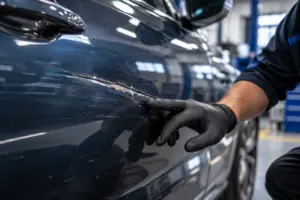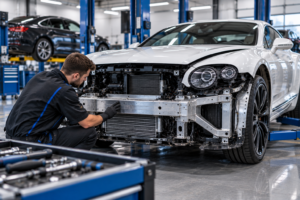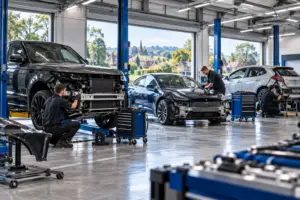
If your car has lane assist, adaptive cruise control or automatic emergency braking, a crash or even a windscreen replacement can knock its cameras and sensors out of true.
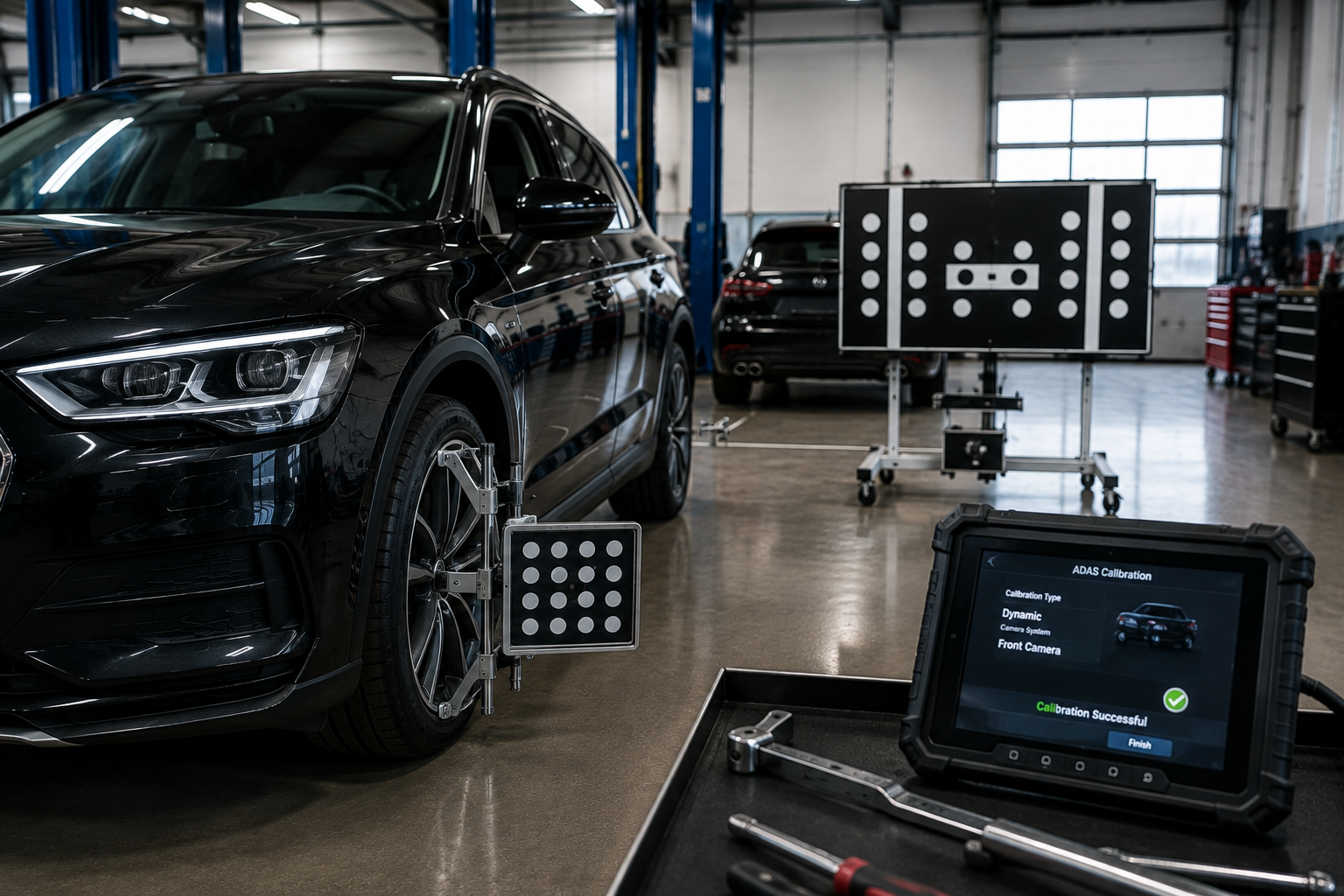
Static ADAS calibration is carried out in a workshop using fixed target boards and precise measurements while the car is stationary. Dynamic calibration is done by driving the car on the road at a set speed so the system can recalibrate itself against real-world references. Many modern vehicles need both, performed in sequence.
What Is ADAS Calibration, and Why Does It Need Static or Dynamic Methods?
ADAS stands for Advanced Driver Assistance Systems: the cameras, radar and ultrasonic sensors behind lane-keep assist, adaptive cruise control, automatic emergency braking and blind-spot monitoring. A collision, a new windscreen, or a replaced bumper can shift a sensor’s position by a fraction of a degree.
What Is Static ADAS Calibration?
Static calibration happens entirely within the workshop. The car is positioned precisely on a level floor, and target boards, laser measuring equipment and diagnostic software are used to recalibrate the sensor against known fixed points.
What Is Dynamic ADAS Calibration?
Dynamic calibration takes the opposite approach. The car is driven on a real road, usually at a defined speed range and for a set distance, while the system recalibrates itself against lane markings and road features.
Static vs Dynamic ADAS Calibration: Which Does Your Car Need?
- Static only — Some older or simpler ADAS setups only require workshop-based calibration.
- Dynamic only — Some radar and rear-sensor systems are calibrated exclusively via a road drive.
- Static then dynamic — Increasingly common on premium marques.
Why Does This Matter After a Crash or Windscreen Replacement?
A car that looks perfectly repaired can still have an ADAS system reading the road incorrectly — enough for automatic emergency braking to trigger late, or lane-keep assist to nudge the car in the wrong direction.
What Happens If ADAS Calibration Is Skipped or Done Incorrectly?
Skipping calibration leaves safety systems operating on outdated or wrong reference points, and falls outside manufacturer-approved repair standards, which matters for warranty and insurance claims.
Frequently Asked Questions
Does every car need both static and dynamic ADAS calibration?
No. The requirement depends on the manufacturer and which systems were affected by the repair.
How long does ADAS calibration take?
Timescales vary by vehicle and by how many systems need recalibrating.
Can dynamic calibration be done in bad weather?
Not reliably. Heavy rain, snow, or poor visibility can prevent the drive from completing successfully.
Will my insurer pay for ADAS calibration after a crash?
Yes, where the calibration is a necessary part of the approved repair.
Does a windscreen replacement always require recalibration?
In most cases involving a forward-facing camera mounted to or near the windscreen, yes.
Can I tell if my ADAS has been calibrated correctly?
Not from the outside — there’s no visible sign that a system is out of calibration.
Getting It Right
At Crash Specialist Garage, we calibrate ADAS systems in-house across all 15 marques we work with. Get in touch for an assessment or a quote — we’ll confirm exactly what your vehicle needs before any work begins.