
Your car’s cameras and radar were set up to look at the road from one exact position. Move that position, even slightly, and the system can be looking at a different road from the one it thinks it sees.
ADAS recalibration is needed whenever a repair or replacement changes the position, angle or mounting of a camera, radar or sensor, or the structure and geometry around it. Common triggers include windscreen replacement, front or rear bumper repair, structural or suspension work, wheel alignment changes and any collision that disturbs a sensor, even if no warning light appears.
That is the short answer. The longer one matters, because the repairs that trigger recalibration are not always the ones owners expect, and the consequences of missing one are invisible until the moment a safety system is needed.
What Is ADAS Recalibration and Why Does It Matter After a Crash?
ADAS stands for advanced driver assistance systems. These are the features that watch the road on your behalf: autonomous emergency braking, adaptive cruise control, lane departure warning, lane keep assist, blind spot monitoring, parking sensors and surround-view cameras.
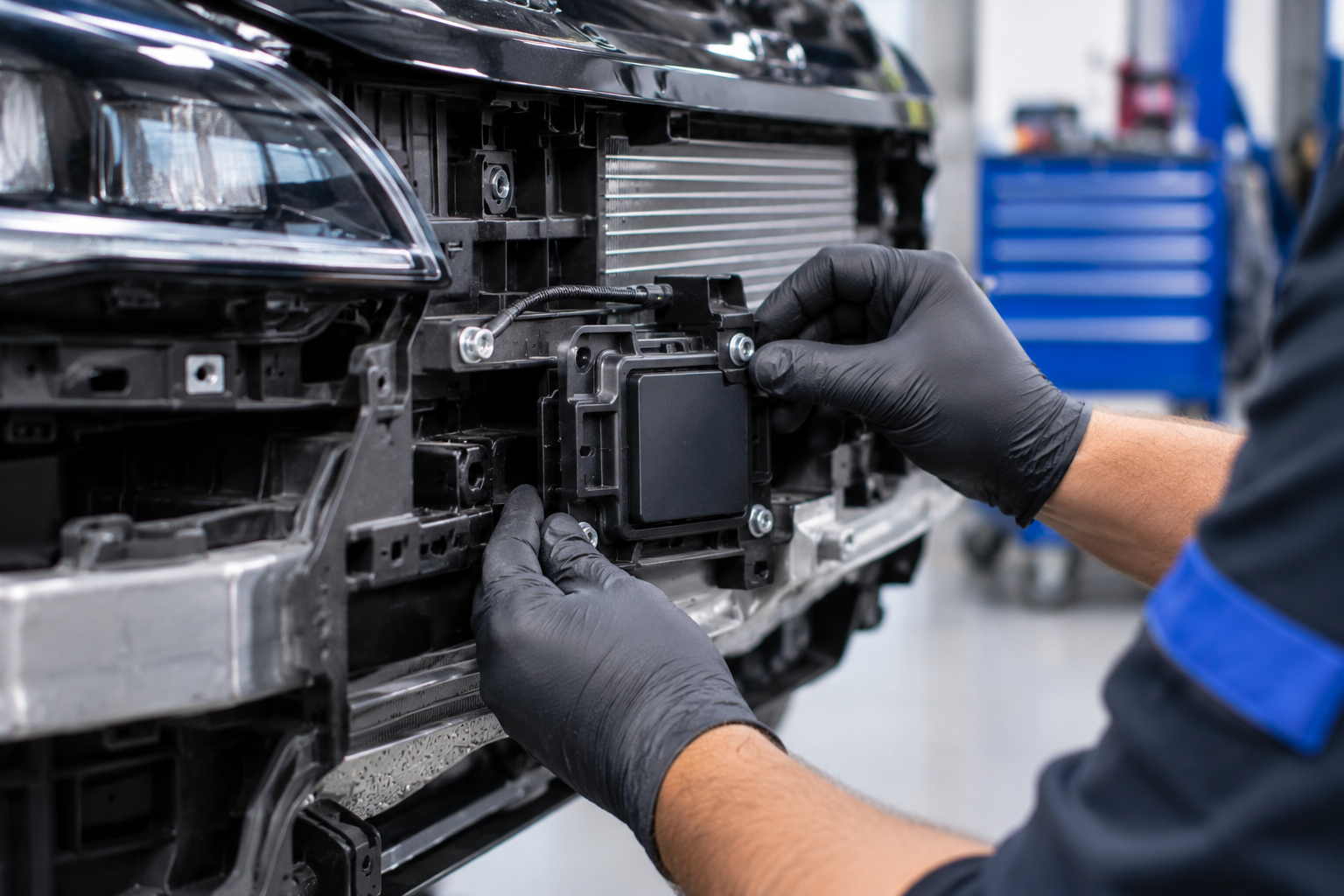
They depend on sensors. Forward-facing cameras are typically mounted behind the windscreen. Radar units sit behind bumpers, badges or grilles. Ultrasonic sensors are set into bumper skins. Each one is aligned to the vehicle’s centreline and geometry, and the software interprets what it sees on that basis.
Recalibration is the process of re-establishing that alignment so the system measures distances, lanes and objects correctly again. It is done with manufacturer-specified procedures and equipment, not by eye. A sensor that has shifted by a small angle at the car can be reading well off target by the time it is looking at something far down the road.
After a crash, this becomes a safety question rather than a technical footnote. A car that looks perfect on the outside can still have a camera or radar that is fractionally out of position, and a system that is slightly wrong can be more dangerous than one that is switched off, because the driver trusts it.
Which Repairs Trigger ADAS Recalibration?
There is no single list that covers every make and model, because each manufacturer publishes its own requirements. What follows are the repair types that most commonly call for a recalibration check, and the reasoning behind each.
Windscreen replacement
The forward camera usually looks through the windscreen. A new screen sits slightly differently, and the glass itself affects what the camera sees. Replacing it normally means the camera needs recalibrating, even if the camera was never touched.
This catches people out because windscreen replacement is often treated as a quick, routine job. On a modern car it is a calibration job as well.
Front and rear bumper repair or replacement
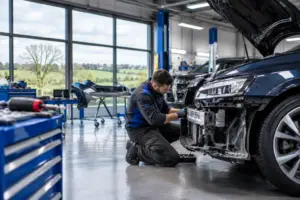
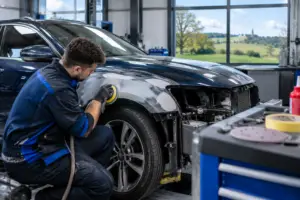
Radar units, parking sensors and, on some cars, cameras are mounted in or behind bumpers. Removing a bumper to repair it, repainting it, or fitting a new one can alter sensor positions. Even paint on the wrong area in front of a radar can interfere with it, which is why the finish applied over sensor zones matters as much as the repair beneath it.
Structural and panel repair
If a repair changes body geometry, for example straightening a front chassis leg, replacing an inner wing or repairing a quarter panel, the mounting points for sensors can move with it. Sensors are aligned to a line through the car. If the car is out of true by even a small amount, recalibrating to a faulty reference simply builds the error in. That is why measuring the body properly before any calibration is the first step, not an optional extra.
Suspension, steering and wheel alignment work
Camera and radar systems assume the car travels in the direction it points. If the thrust angle or ride height changes, the sensors’ picture of “straight ahead” changes too. Replacing suspension components after an impact, or adjusting wheel alignment, can therefore require a recalibration, and many manufacturers specify an alignment check before calibrating.
Door mirrors, side panels and rear-quarter work
Blind spot monitoring often relies on radar behind the rear bumper corners or sensors in the mirrors. Mirror replacement, rear-quarter repair or a side-impact repair can all move these. A scrape that looks cosmetic can be enough.
Airbag deployment and sensor replacement
When a sensor is replaced, whether it is a camera, a radar unit or a related module, the new part needs to be coded to the car and calibrated. Airbag deployment can bring in several of these changes at once, so the calibration list on a crash repair can be long.
Battery disconnection and software updates
Some manufacturers require system checks after power loss or module reprogramming, as a precaution.
Can an ADAS Recalibration Be Needed If Nothing Looks Damaged?
Yes, and this is the point that matters most for owners.
A warning light is not a reliable test. A sensor can be misaligned and still pass its own self-check, because the self-check confirms the unit is working, not that it is pointing in the right direction. A camera knocked by a few degrees may report no fault at all.
That means you cannot judge from the dashboard whether a recalibration is needed, and you cannot assume the answer is no because the car “drives fine”. The decision should come from what was repaired and what the manufacturer’s procedure requires, and it should be made by someone qualified to read that procedure.
It also means that a crash with no obvious sensor damage still deserves a conversation. Even a low-speed bump to a bumper cover can shift the structure behind it.
How Is ADAS Recalibration Carried Out?
There are broadly two approaches, and many cars need one or both.
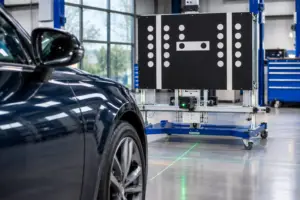
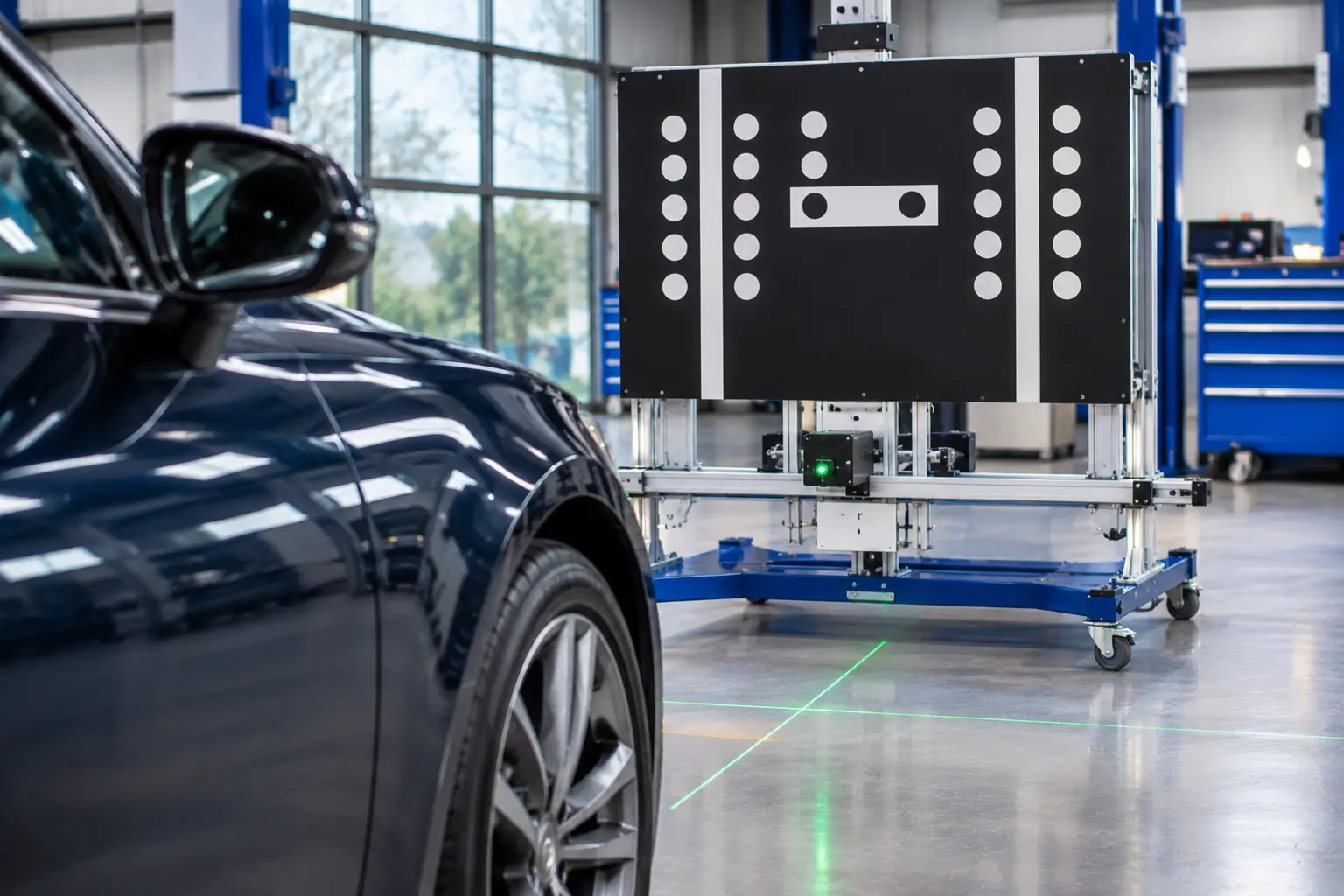
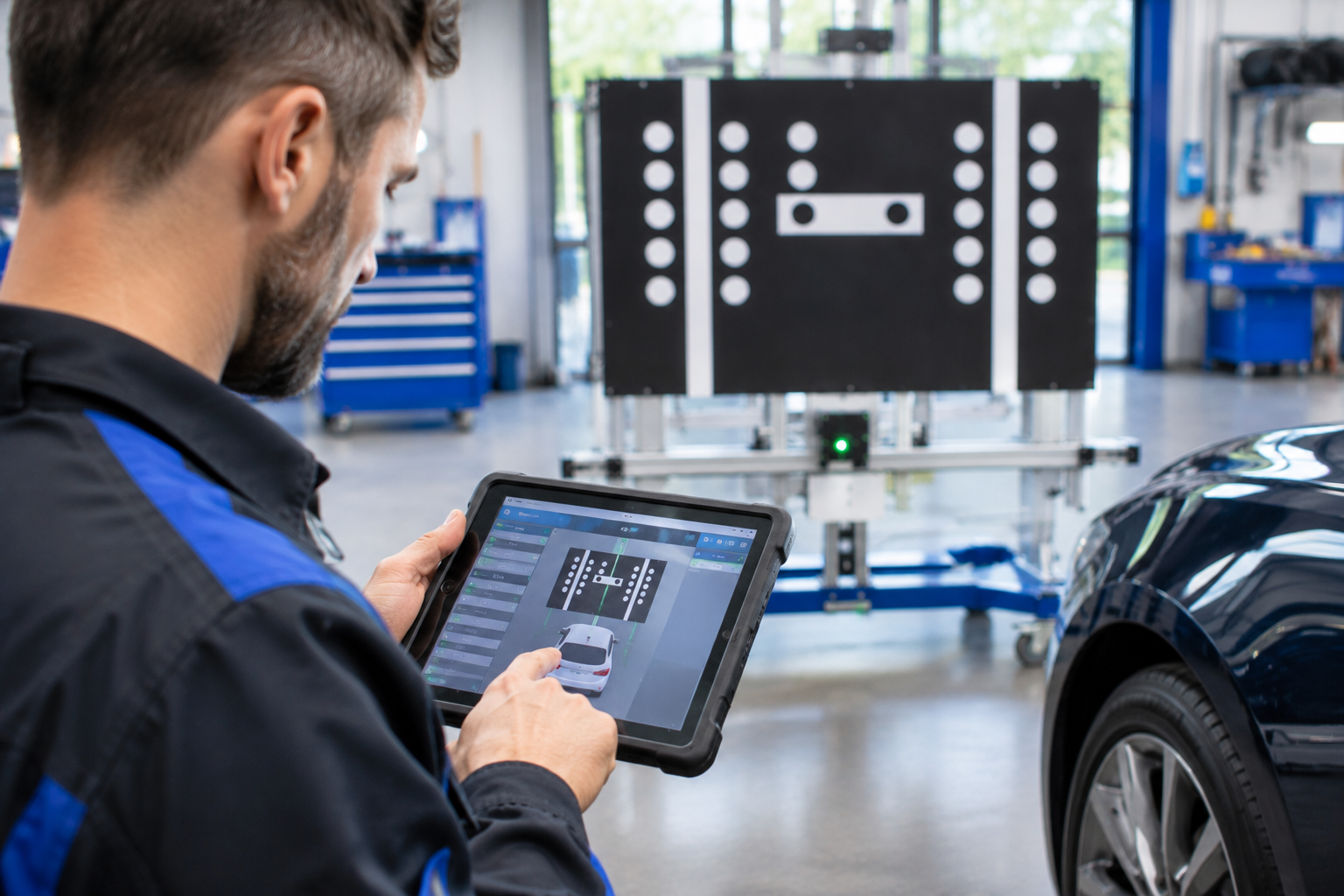
Static calibration is done in the workshop. The car is placed in a controlled position in front of target boards or reference equipment, measured and aligned precisely to the vehicle’s centreline, and the system is calibrated against the targets. It needs space, level floors, controlled lighting and accurate setup, which is where the rig and the technician’s skill both matter.
Dynamic calibration is done on the road, with diagnostic equipment connected, while the car is driven under specified conditions such as set speeds and clear lane markings. It depends on road and traffic conditions co-operating.
The right method for your car is the one the manufacturer specifies. Some require both. The result should be a printed report showing what was calibrated, the equipment used and a pass result, not a verbal “all done”.
What Should You Ask Your Repairer About ADAS Recalibration?
You are entitled to ask, and a good repairer will welcome the questions. Here are the ones that tell you the most.
- Did you check which sensors my repair affected? The answer should name the systems, not just say “yes”.
- Do you follow the manufacturer’s procedure for my car? Requirements differ between makes, and between models of the same make.
- Is the calibration done here, or sent out? Either can be fine, but you should know, and the paperwork should say so.
- Was the car measured and aligned before calibration? Calibrating a car that is out of true locks in the error.
- Will I receive a calibration report? You should have a written record at handover. It is useful evidence if you later sell the car or make a claim.
If a bodyshop cannot answer these clearly, that tells you something.
Who Pays for ADAS Recalibration After an Accident?
If the recalibration is a necessary part of repairing accident damage, it belongs in the repair estimate and the claim like any other repair operation, whether you are claiming on your own policy or against a third party.
Two points are worth keeping in mind. First, the repairer’s estimate should list calibration explicitly. If it does not, ask why. Second, you can choose your own repairer rather than accept one chosen for you, and you are entitled to a repair that returns the car to its pre-accident condition.
If a quote seems to leave calibration out, query it before the work begins, not afterwards. It is far easier to add an operation to an estimate than to reopen a closed claim.
Why Does the Standard of the Repairer Matter Here?
ADAS calibration is only as good as the repair beneath it. The sequence matters: assess the damage, repair the structure to the manufacturer’s method, measure the result, refit and check the sensors, then calibrate. Skip or compress any step and the final calibration can be right on paper and wrong on the road.
That is why independent approval is worth looking for. Crash Specialist Garage is BSI approved, which means its processes, equipment, records and repair methods are independently assessed rather than self-declared. For ADAS work specifically, we keep to the vehicle manufacturer’s published procedures and document what was done.
We repair prestige and performance marques as well as everyday cars, and the principle is the same across all of them: the safety systems your car was built with should work the way the manufacturer intended when it leaves us.
FAQ
Which repairs require ADAS recalibration?
Repairs that change the position, angle or mounting of a camera, radar or sensor, or the body geometry around it, typically require recalibration. Common examples are windscreen replacement, bumper removal or replacement, structural repair, suspension or alignment work, and replacing a sensor or module. Your car’s manufacturer sets the exact requirements.
Do I need ADAS recalibration after a windscreen replacement?
Often, yes. The forward camera usually looks through the windscreen, and a new screen changes its position and optical path. Many manufacturers require the camera to be recalibrated after a screen is fitted, even if the camera itself was not removed. Check the requirement for your specific make and model.
Can ADAS need recalibrating if no warning light is showing?
Yes. A warning light shows that a system has detected a fault, not that every sensor is pointing exactly where it should. A sensor can be slightly misaligned and still pass its own checks. The need for recalibration depends on the repair carried out, not on whether a light is on.
What is the difference between static and dynamic ADAS calibration?
Static calibration is done in the workshop using target boards and precisely positioned equipment. Dynamic calibration is done on the road, driving under specified conditions with diagnostic equipment connected. Some vehicles need one method, some need both. The vehicle manufacturer specifies which applies.
Should I get proof that ADAS recalibration has been done?
Yes. You should receive a written calibration report or record showing which systems were calibrated and the result. It confirms the work was carried out and is useful if you later sell the car, or if a question arises about the repair.
Does Crash Specialist Garage carry out ADAS recalibration?
Yes. Crash Specialist Garage in Macclesfield carries out ADAS recalibration as part of accident repair, working to manufacturer procedures and documenting the result. We handle accident repair, bodywork and insurance claims only; we do not offer general servicing or MOT.
Make Sure the Repair Behind the Panels Is Right
A repair that looks flawless and a repair that leaves your safety systems working correctly are two different results, and only one of them matters on the day you need your car to brake for you.
If your car has been in an accident, or you have had a windscreen, bumper or sensor area repaired elsewhere and are unsure whether calibration was done, contact Crash Specialist Garage in Macclesfield to arrange an assessment.