Introduction
Handing your car over to a bodyshop after an accident is a significant act of trust. You’re leaving a potentially valuable asset in someone else’s hands, often at a stressful time, without necessarily knowing what to expect or what questions to ask.
The good news is that a few well-chosen questions — asked before you sign anything — can tell you a great deal about whether you’re dealing with a repairer you can trust. A quality bodyshop will answer clearly, confidently, and in writing. A poor one will be evasive, vague, or dismissive.
Here are the five questions that every driver should ask before handing over their keys.
Question 1: Do You Have Experience with My Specific Make and Model?
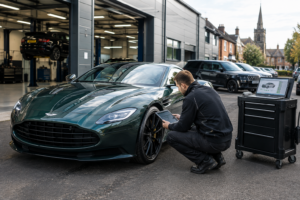
This is the most fundamental question, and it matters more than it might appear. Not all bodyshops are equipped or trained to repair all vehicles. A shop that handles high volumes of standard family cars may not have the knowledge, equipment, or parts relationships to properly repair a BMW, Range Rover, Mercedes, or Porsche.
For prestige and specialist vehicles in particular, this matters at every level of the repair: the structural assessment process, the paint matching, the ADAS calibration, the parts sourcing, and the repair techniques for specialist materials like aluminium and carbon fibre.
A good answer: The repairer confidently names other vehicles of your type that they’ve repaired, mentions any relevant manufacturer approvals or accreditations, and can speak specifically about the requirements of your vehicle rather than just offering a general assurance.
A warning sign: “Yes, we repair everything.” A genuinely specialist repairer knows the difference between vehicles and will tell you specifically what they can do for yours.
Accident Repair in Macclesfield: What to Look for in a Bodyshop
Question 2: Will You Use OEM Parts Throughout the Repair?
Parts quality is one of the most significant hidden variables in accident repair. Insurers and some bodyshops routinely use non-OEM (aftermarket or pattern) parts, which cost less but may not match the specification, safety performance, or finish quality of the genuine manufacturer part.
For prestige vehicles in particular, OEM parts matter enormously — for safety, for fit and finish, for manufacturer warranty preservation, and for resale value.
A good answer: “Yes, we use OEM parts as standard and we’ll put that in writing.” A quality repairer will confirm this in the repair authorisation without hesitation.
A warning sign: Vague language like “we use quality parts” or “we source from approved suppliers” without specifying whether those suppliers are the manufacturer’s own parts network.
OEM vs Non-OEM Parts: Why It Matters More on Prestige Vehicles
Question 3: Do You Carry Out ADAS Calibration — and Do You Have the Right Equipment for My Vehicle?
If your vehicle has advanced driver assistance systems — and most cars built after around 2018 do — it will require ADAS calibration after any repair that affects the sensors or cameras. This includes bumper repairs, windscreen replacement, mirror replacement, and any work near sensor locations.
ADAS calibration requires specialist equipment and manufacturer-specific software. Not all bodyshops have this capability for all makes — and some don’t have it at all.
A good answer: The repairer confirms they have the specific calibration equipment for your make and model, explains whether static or dynamic calibration will be needed, and offers written confirmation of calibration completion with the finished repair.
A warning sign: “Our diagnostic equipment covers all makes.” Generic diagnostic tools are not the same as manufacturer-specific ADAS calibration equipment.
What Is ADAS Calibration and Why Every Modern Car Needs It After a Collision
Question 4: Will You Carry Out a Structural Assessment Before Beginning Work?
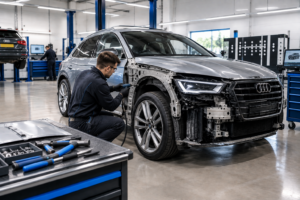
Surface damage — the dented panel, the cracked bumper — is what you can see after a collision. What you can’t always see is whether the collision has also affected the vehicle’s structural integrity. Crumple zone deformation, chassis rail misalignment, sub-frame displacement — these can all occur without being visibly obvious.
A proper structural assessment requires specialist equipment: chassis measurement systems with manufacturer-specific dimensional data. Without this, a repair can look perfect on the surface while leaving underlying structural issues unaddressed.
A good answer: The repairer confirms that a structural assessment using a measurement system is included as part of their standard process before any repair work begins.
A warning sign: The repairer proceeds to a repair estimate without mentioning structural assessment, or treats it as an optional extra rather than a fundamental step.
Structural Damage After a Crash: Why It’s Not Always Visible from the Outside
Question 5: What Is Your Repair Guarantee, and What Does It Cover?
A repairer who is confident in their work will stand behind it. A clear, written repair guarantee is one of the most important commitments you should get before handing over your keys. It tells you what’s covered if something isn’t right after you collect the car, how long the guarantee lasts, and what the process is if you need to use it.
Be specific about what you’re asking: does the guarantee cover both workmanship and materials? Does it apply to the paint finish? What is the process if a concern arises — and how quickly will it be resolved?
A good answer: A clear, written guarantee covering workmanship and materials, with a specified duration and a clear process for raising concerns.
A warning sign: A repairer who is vague about their guarantee, who doesn’t offer it in writing, or who becomes defensive when you ask about it.
Bonus: Can I See Your Facilities?
This isn’t a question you have to ask, but if you have the opportunity, asking for a quick look around can be very informative. A quality specialist bodyshop will have a dedicated spray booth, calibration equipment, jig facilities, and a well-organised workshop. They’ll be proud to show you around. A bodyshop with nothing to hide has nothing to hide.
Conclusion
The right questions — asked at the right time — can mean the difference between a repair you can trust and one you’re uncertain about months after the fact. Ask about vehicle-specific experience, OEM parts, ADAS calibration, structural assessment, and the repair guarantee. If the answers are clear, specific, and available in writing, you’re probably in the right place.
At Crash Specialist Garage in Macclesfield, we welcome all of these questions. We’re a specialist repairer — we work on prestige vehicles every day, and we’re confident in what we do and how we do it. If you’d like to have a conversation before committing to a repair, give us a call.
Related posts:
- Accident Repair in Macclesfield: What to Look for in a Bodyshop
- OEM vs Non-OEM Parts: Why It Matters More on Prestige Vehicles
- What Is ADAS Calibration and Why Every Modern Car Needs It After a Collision
Frequently Asked Questions
Before. These questions should form the basis of your decision about whether to use a particular bodyshop, so ask them when you first make contact or visit — before you commit to anything.
That’s a significant concern. A reputable repairer will always put the parts specification in writing as part of the repair authorisation. If they won’t, you might want to look elsewhere.
Yes. You have the right to choose your own repairer — your insurer cannot compel you to use their approved network. Exercise this right, do your research, and choose a bodyshop that can answer these five questions properly.
Raise it with the bodyshop immediately and in writing. A good repairer will address legitimate concerns. If they don’t respond appropriately, you can escalate through their complaints process, and ultimately to the Financial Ombudsman Service if the claim was handled through insurance.
For very minor cosmetic repairs on standard vehicles, some of these questions matter less. But for any repair on a prestige vehicle — or any repair involving bumpers, structural elements, or windscreens on a modern car with ADAS — all five are relevant.
External sources: