Introduction
If you’ve bought a new or nearly-new car in the last five years, it almost certainly has ADAS — Advanced Driver Assistance Systems. Lane-keeping assist, automatic emergency braking, blind-spot warning, adaptive cruise control, and parking sensors are now standard or near-standard on most modern vehicles.
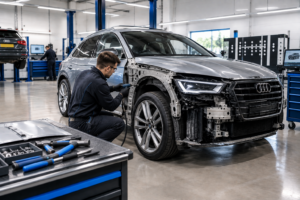
These systems have genuinely saved lives. But they rely on a network of cameras, radar units, and ultrasonic sensors — many of which are positioned in areas commonly affected by collision damage: the bumpers, windscreen, door mirrors, and grille.
After an accident, even one that appears relatively minor, these sensors can be knocked out of alignment. When that happens, the safety systems that depend on them may no longer work correctly — and in many cases, you won’t know there’s a problem until it’s too late.
What Are ADAS Systems?
ADAS stands for Advanced Driver Assistance Systems — an umbrella term for the suite of safety and convenience technologies found in modern vehicles. Common systems include:
- Autonomous Emergency Braking (AEB) — automatically applies the brakes if a collision is detected
- Lane Departure Warning / Lane Keep Assist — alerts you or actively steers to keep you in lane
- Adaptive Cruise Control — maintains a set speed and distance from the vehicle ahead
- Blind Spot Monitoring — warns when a vehicle is in your blind spot
- Rear Cross Traffic Alert — detects vehicles approaching from the side when reversing
- 360-degree parking sensors and cameras — guide you when manoeuvring
- Traffic Sign Recognition — reads and displays road signs
- Driver Attention Monitoring — detects fatigue or distraction
Each of these systems relies on sensors placed at specific points around the vehicle, calibrated to precise angles and distances. When that calibration is disrupted — even slightly — the system’s ability to function accurately is compromised.
Where Are the Sensors, and Why Are They Vulnerable?
- Forward-facing cameras are typically mounted behind the windscreen — vulnerable in any impact affecting the windscreen, bonnet, or front structure
- Radar units are often housed in the front grille or behind the bumpers — directly in the path of most frontal and rear-end collisions
- Ultrasonic parking sensors are embedded in the bumper skin — vulnerable in even very minor parking impacts
- Lidar units (on higher-end vehicles) may be mounted in the roof, mirrors, or bumpers
- Side cameras and radar for blind-spot systems are typically in the door mirrors or rear quarters
An impact doesn’t have to be severe to affect these sensors. A light bump that dents a bumper, cracks a grille, or misaligns a mirror can be enough to move a sensor out of its calibrated position.
What Is ADAS Calibration?
Calibration is the process of resetting a sensor to its correct position and angle so that the system it supports functions accurately. There are two main types:
Static calibration
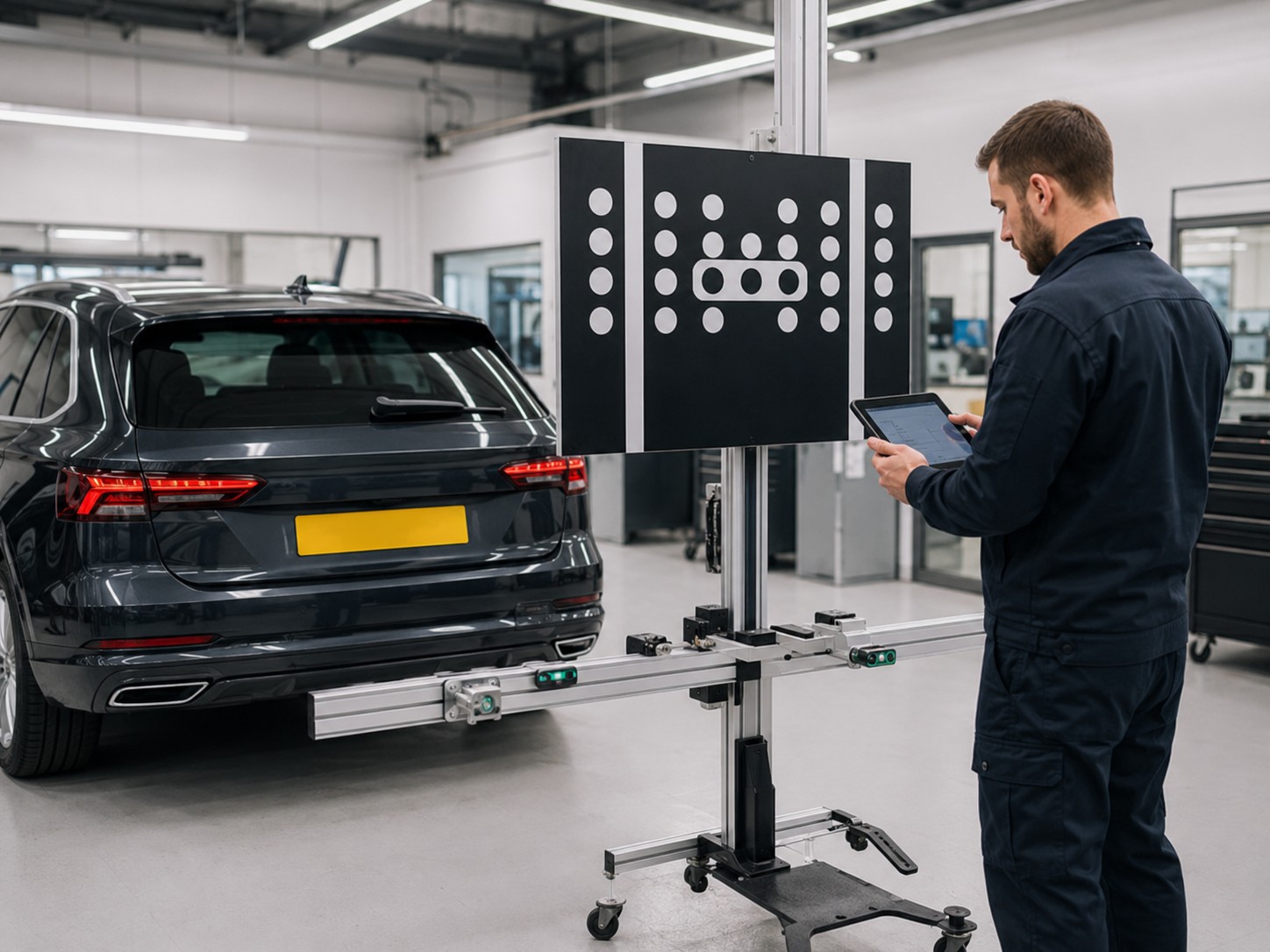
Static calibration is carried out in a controlled workshop environment. The vehicle is positioned at a precise distance from calibration targets, and specialist software is used to align the sensors correctly. The workshop must be level, free from external light interference, and of a specific size — which is why not every bodyshop can carry this out.
Dynamic calibration
Dynamic calibration is carried out on the road. The vehicle is driven at a specific speed on a road with clearly visible lane markings while the calibration software runs in the background, using real-world conditions to reset the system.
Manufacturer-specific requirements
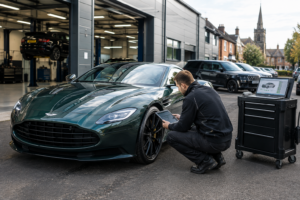
Critically, calibration requirements vary significantly between manufacturers — and even between models within the same brand. A BMW, a Range Rover, and a Mercedes will each have different procedures, different software requirements, and different equipment needs. A repairer without the specific tools and software for your vehicle cannot carry out calibration correctly.
Why Calibration Is Essential After a Collision
Even minor impacts can affect calibration
Any of the following can require calibration:
- Bumper replacement or repair
- Windscreen replacement
- Wing mirror replacement
- Front or rear panel repair
- Wheel alignment changes following suspension damage
- Any repair involving components near sensor locations
The consequences of skipping calibration
A vehicle with miscalibrated ADAS systems may appear completely normal to drive. Dashboard warning lights may not activate. But the safety systems are not working as designed. In a situation where AEB should engage, or where lane-keep assist should intervene, the system may fail to respond — or respond incorrectly.
Your legal position
Returning a vehicle to the road with ADAS systems in a miscalibrated state could raise questions of negligence — both for the repairer who failed to carry out calibration and potentially for the vehicle owner. Make sure calibration is part of your repair specification, and ask for written confirmation of completion.
What to Ask Your Repairer
- Do you carry out ADAS calibration for my specific make and model?
- Do you have the manufacturer-specific software and equipment required?
- Will calibration be included in the repair scope?
- Will you provide written confirmation that calibration has been completed and signed off?
A specialist repairer will be able to answer these questions clearly and confidently. If a repairer is vague or dismissive about ADAS calibration, that is a serious warning sign.
Top 5 Common Car Repair Mistakes to Avoid After an Accident
ADAS Calibration and the Insurance Claim
ADAS calibration is a necessary and covered element of a proper post-accident repair — it is not an optional add-on. If an insurer’s approved repairer is not including calibration in the repair scope for a vehicle that requires it, you have grounds to challenge this.
Your Insurer Can’t Tell You Where to Get Your Car Repaired — Here’s What the Law Actually Says
Conclusion
ADAS systems are one of the most significant safety advances in modern motoring. But they only work if they’re properly calibrated — and a collision, even a minor one, can disrupt that calibration in ways that aren’t immediately visible.
At Crash Specialist Garage in Macclesfield, we carry out ADAS calibration as a standard part of our repair process on all vehicles that require it. We have the manufacturer-specific equipment and software needed for the prestige and specialist vehicles we work on, and we provide written confirmation of calibration completion on every relevant repair.
Related posts:
- Top 5 Common Car Repair Mistakes to Avoid After an Accident
- How Long Does Accident Repair Actually Take — and What Affects the Timeline?
- OEM vs Non-OEM Parts: Why It Matters More on Prestige Vehicles
Frequently Asked Questions
Not every accident, but any impact affecting areas where sensors are located — front bumper, rear bumper, windscreen, mirrors — should be assessed for calibration requirements. Your repairer should carry out a diagnostic check as part of the process.
It depends on the vehicle and the number of systems requiring calibration. Static calibration typically takes between one and two hours per system. Some vehicles require multiple calibration procedures for different systems.
Not always. Some systems will show a warning light, but others may continue to function apparently normally while not working accurately. The only way to be certain is to have the systems checked by a repairer with the appropriate diagnostic equipment.
Yes — it should be included as part of the repair cost. If an insurer disputes this, it’s worth challenging, as calibration is a necessary element of returning the vehicle to its pre-accident condition.
Specialist equipment is required. Calibration needs manufacturer-specific software, calibration targets, and in many cases a level, controlled workshop environment of a specific size. Not all bodyshops have this capability.
External sources: