Introduction
When your car goes in for accident repair, you probably assume that the parts going back on it are the same quality as the ones that came off. In many cases, that assumption is wrong — and for drivers of prestige vehicles, the difference matters significantly.
The distinction between OEM and non-OEM parts is one of the most important and least-discussed aspects of accident repair. Insurers and approved repairers don’t always volunteer this information, and most drivers only find out which type of parts were used when they notice something isn’t quite right weeks or months after the repair.
What Does OEM Mean?
OEM stands for Original Equipment Manufacturer. OEM parts are those made by — or to the precise specification of — the vehicle manufacturer. They are identical to the parts fitted to your car when it left the factory: same materials, same tolerances, same quality control.
OEM parts are typically supplied through the manufacturer’s authorised parts network and carry a manufacturer warranty. They are designed to integrate perfectly with surrounding components, match the vehicle’s finish and specification, and meet all safety standards the vehicle was originally built to.
What are non-OEM parts?
Non-OEM parts — also referred to as pattern parts, aftermarket parts, or non-genuine parts — are produced by third-party manufacturers. They are designed to approximate the original part but are not produced by or to the specification of the vehicle manufacturer.
The quality of non-OEM parts varies enormously. Some are manufactured to reasonable standards; others are significantly inferior. The common thread is that they are produced to a lower cost, which is why they are attractive to insurers managing repair budgets.
Why Insurers Often Prefer Non-OEM Parts
The economics are straightforward. A genuine manufacturer part for a prestige vehicle can cost significantly more than a pattern equivalent. On a high volume of claims, the difference adds up to substantial savings for the insurer.
Approved repairer networks are often contractually required to use parts from designated suppliers — and those suppliers are not always the manufacturer’s own parts network. The use of non-OEM parts is baked into the cost model of many approved repair schemes, and drivers are rarely told this explicitly.
The Risks of Non-OEM Parts on Prestige Vehicles
Safety
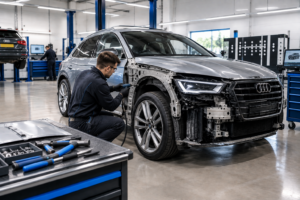
On safety-critical components — bumpers, structural panels, airbag housings, crumple zones — the use of non-OEM parts is a genuine safety concern. These components are engineered to precise specifications that govern how they behave in a collision. A pattern part that looks identical may not perform identically when it matters most.
For prestige and performance vehicles, which are often engineered to exceptionally fine tolerances, this risk is amplified. The interplay between body panels, safety systems, and structural components on a modern BMW, Porsche, or Range Rover is complex — and non-OEM substitutes can introduce unpredictable variables.
Fit and finish
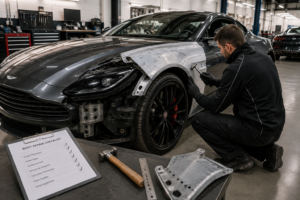
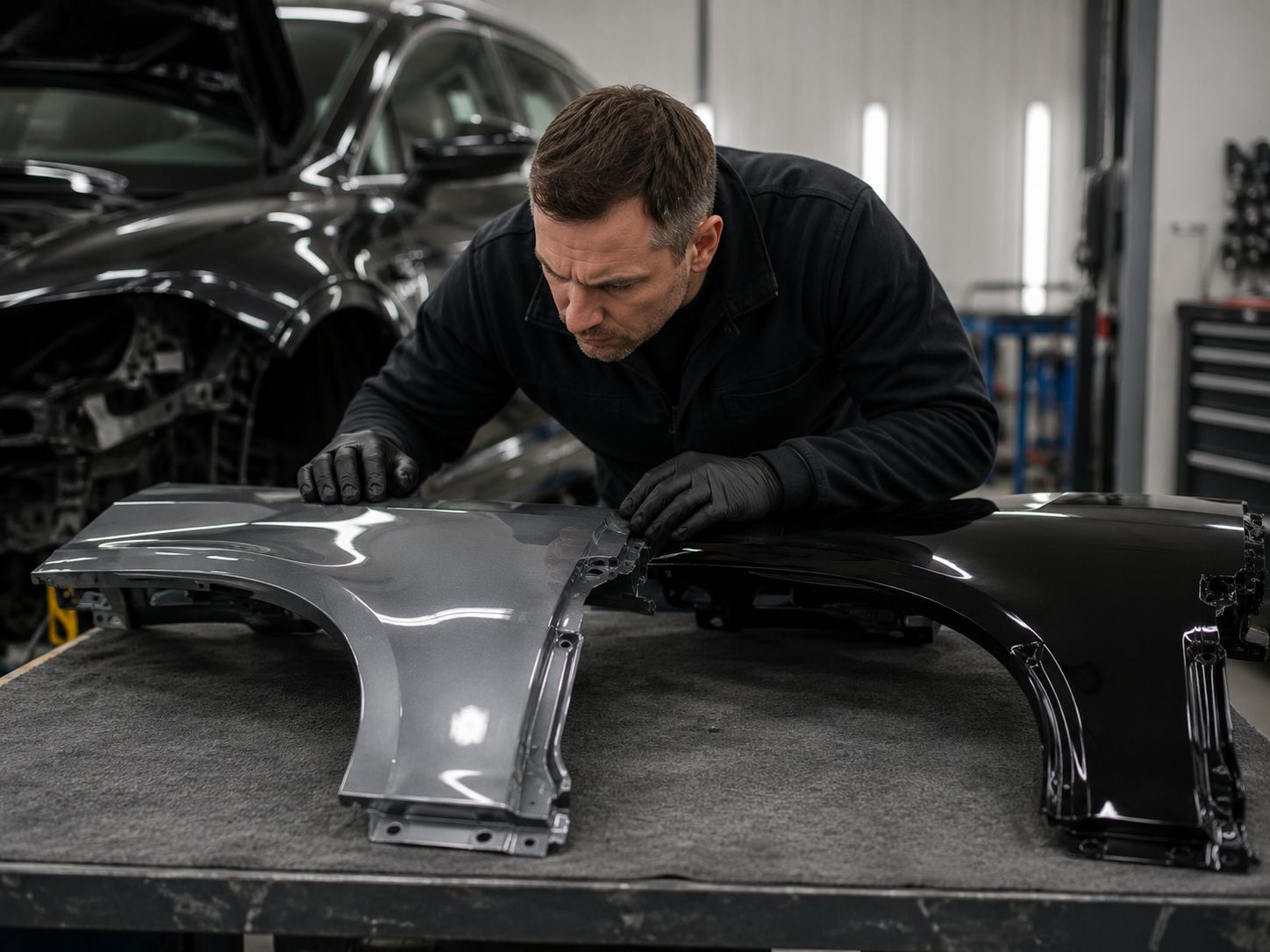
Prestige vehicles are manufactured to tight tolerances. Panel gaps, surface finish, paint adhesion — all are engineered to exacting standards. Non-OEM panels frequently don’t match these tolerances precisely, resulting in slightly misaligned gaps, inconsistent surface texture, or paint that doesn’t adhere or age in the same way as the surrounding panels.
Manufacturer warranty
Many vehicle manufacturers’ warranties specify that repairs must use genuine parts to maintain coverage. Fitting non-OEM parts in an accident repair can void or compromise warranty protection — particularly significant on newer vehicles still within their warranty period.
Resale value
When a car is sold or part-exchanged, its service and repair history is scrutinised. A vehicle repaired using non-genuine parts — particularly if discoverable from repair records — may attract a lower offer. For prestige vehicles, where buyers are paying a premium partly for provenance and condition, this devaluation can be significant.
Your Legal Entitlement to OEM Parts
The legal principle governing accident repair is that the at-fault party must restore your vehicle to its pre-accident condition. A car repaired with non-OEM parts is not, in the truest sense, in the same condition as before the accident — and you are entitled to challenge this.
- You can insist on OEM parts as a condition of authorising repair
- If an insurer is trying to impose non-OEM parts, you can challenge this through their complaints process and, if necessary, the Financial Ombudsman Service
- For vehicles still under manufacturer warranty, the case for OEM parts is particularly strong
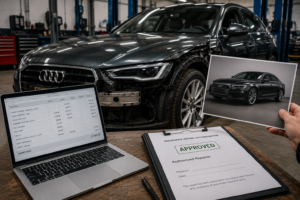
Get this confirmed in writing before any work begins. Ask the repairer to specify in the repair authorisation that OEM parts will be used throughout.
Your Insurer Can’t Tell You Where to Get Your Car Repaired — Here’s What the Law Actually Says
Make-Specific Considerations
BMW and Audi — aluminium panels
Both BMW and Audi make extensive use of aluminium in their body structures. Aluminium repair requires specialist equipment and training — and OEM aluminium panels are machined and formed to specifications that pattern parts rarely replicate accurately.
Range Rover — composite and specialist materials
Range Rover bodies incorporate a mix of steel, aluminium, and composite materials. The interaction between these materials — and the precise way they’re joined — is central to the vehicle’s rigidity and safety. Non-OEM panels in this context can introduce structural inconsistencies.
Mercedes and Porsche — safety system integration
Both Mercedes and Porsche integrate safety systems extensively into their body structure. Bumper assemblies often house multiple sensors that must align precisely with ADAS components. A non-OEM bumper that is even slightly out of specification can affect sensor positioning and, by extension, the function of safety systems.
What Is ADAS Calibration and Why Every Modern Car Needs It After a Collision
Conclusion
The choice between OEM and non-OEM parts may seem like a technical detail. On a prestige vehicle, it’s anything but. It affects safety, warranty, resale value, and the quality of finish that defines the ownership experience.
At Crash Specialist Garage in Macclesfield, we use genuine OEM parts on every repair, without exception. It’s a commitment we make to every customer — and one we’re happy to put in writing.
Related posts:
- What Is ADAS Calibration and Why Every Modern Car Needs It After a Collision
- Top 5 Common Car Repair Mistakes to Avoid After an Accident
- Your Insurer Can’t Tell You Where to Get Your Car Repaired — Here’s What the Law Actually Says
Frequently Asked Questions
Ask for the parts invoices after the repair is complete. Genuine OEM parts will be invoiced from the manufacturer’s parts network. If the supplier is a general parts distributor, the parts may be non-OEM. You can also check whether parts bear manufacturer branding and part numbers.
Yes. You are entitled to have your vehicle restored to its pre-accident condition, which for a prestige vehicle means OEM parts. If the insurer refuses, escalate through their complaints process and, if necessary, to the Financial Ombudsman Service.
For some non-safety-critical, non-structural, non-visible components on older or lower-value vehicles, the argument for OEM parts is less compelling. For prestige vehicles, structural components, safety systems, or anything visible — OEM parts are the right standard.
Occasionally. Genuine parts for specialist or newer vehicles may have slightly longer lead times than pattern parts. A quality repairer will factor this in and order parts as early as possible.
Not typically — but fitting non-OEM parts can affect manufacturer warranty, which may have knock-on implications for certain types of claim. Check your manufacturer warranty terms if in any doubt.
External sources: