Introduction
A Range Rover is not a typical car. It is a statement of engineering ambition, refinement, and status — and when one is involved in an accident, the standards expected of its repair are correspondingly high.
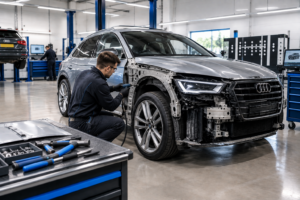
Range Rover owners who find themselves dealing with the aftermath of a collision often discover that not every bodyshop is equipped — or experienced — to handle a repair to the standard these vehicles require. The multi-coat paint finishes, the mixed-material body construction, the sophisticated ADAS systems, and the demanding tolerances of the finished product all place demands on a repairer that go beyond what most bodyshops routinely encounter.
This guide focuses on one of the most technically demanding aspects of Range Rover repair: paint matching. We’ll explain why it’s more complex than it looks, what separates a genuinely excellent result from an acceptable one, and why choosing the right specialist matters so much.
Why Range Rover Paint Matching Is Uniquely Challenging
The finish range is exceptional — and deliberately complex
Range Rover offers one of the most extensive bespoke colour programmes in the industry. Standard colours include a high proportion of complex metallics, pearlescents, and effects finishes — and through the SV Bespoke programme, buyers can specify virtually any colour, including multi-stage finishes that require three or more coats to achieve their visual effect.
These finishes are not straightforward to replicate. A standard solid colour can typically be matched well by a competent painter using the correct reference data. But a Carpathian Grey Pearl, a Lantau Bronze, or a custom commission is an entirely different proposition.
Multi-stage and tri-coat finishes
Many Range Rover colours use a tri-coat or multi-stage process. This means the colour you see is produced by a combination of:
- A base coat providing the primary colour and metallic or pearl substrate
- One or more effect coats that add depth, shift, and iridescence
- A clear lacquer coat that provides gloss, protection, and surface hardness
Each of these coats must be applied to precise thickness tolerances, and the colour perception changes significantly depending on the depth and distribution of the effect layers.
Colour shift and the angle challenge
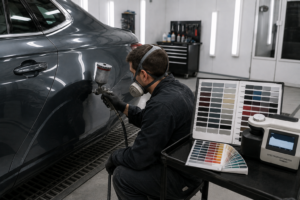
The metallic flake and pearlescent pigments used in complex finishes create colours that look different depending on the viewing angle and the lighting conditions. This “colour shift” behaviour must be matched as well as the base colour — which requires a painter with substantial experience in these finishes, access to manufacturer spectrophotometer data, and the skill to adjust their approach based on test panels.
The blending imperative
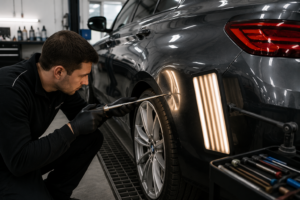
When a panel is repainted — even with a perfect colour match — the micro-texture of the new paint surface is slightly different from the aged surface of the surrounding panels. For this reason, quality refinishing on a Range Rover typically involves blending: applying the repaired colour into adjacent panels so that there is no visible demarcation line between old and new paint.
Mixed Materials: The Other Complexity
Range Rover bodies incorporate steel, aluminium, and composite materials in combination. This mixed-material construction creates specific challenges for repair.
Aluminium repair requirements
Many Range Rover body panels are aluminium. Aluminium behaves very differently from steel: it work-hardens during impact, cannot be repaired using standard steel techniques, and requires dedicated tools, a separated workspace (to prevent contamination from steel particles, which cause galvanic corrosion in aluminium), and specialist training.
Composite and carbon elements
On higher-specification Range Rovers, composite elements — including carbon fibre trim components and structural elements in some variants — require specific repair or replacement approaches. Carbon fibre cannot be repaired in the same way as metal or plastic; structural carbon repairs require specialist materials and processes.
ADAS and Electronics on the Range Rover
Modern Range Rovers are equipped with sophisticated driver assistance systems, including Terrain Response, adaptive cruise control, blind-spot monitoring, rear cross traffic alert, and autonomous emergency braking. The sensors and cameras that support these systems are positioned throughout the vehicle — in the grille, bumpers, mirrors, and windscreen surround — in the same locations most commonly affected by collision damage.
After any repair that affects these areas, proper ADAS calibration is essential. This requires Land Rover-specific diagnostic equipment and software — generic calibration tools are not adequate for the Range Rover’s sophisticated systems.
What Is ADAS Calibration and Why Every Modern Car Needs It After a Collision
OEM Parts: Why Genuine Matters Even More on a Range Rover
The case for OEM parts is always strong on prestige vehicles. On a Range Rover, it is particularly compelling:
- Fit and finish: Range Rover panels are manufactured to tight tolerances. Non-OEM alternatives frequently don’t match these tolerances, resulting in panel gaps and surface inconsistencies that are very difficult to correct
- Safety: Structural panels and bumper assemblies on the Range Rover are engineered to interact with the vehicle’s safety systems in specific ways. A non-OEM equivalent may not replicate this correctly
- Warranty: Land Rover’s warranty conditions specify genuine parts for repairs. Using non-OEM parts during an accident repair can affect remaining warranty coverage
OEM vs Non-OEM Parts: Why It Matters More on Prestige Vehicles
Crash Specialist Garage — Range Rover Accident Repair in Macclesfield
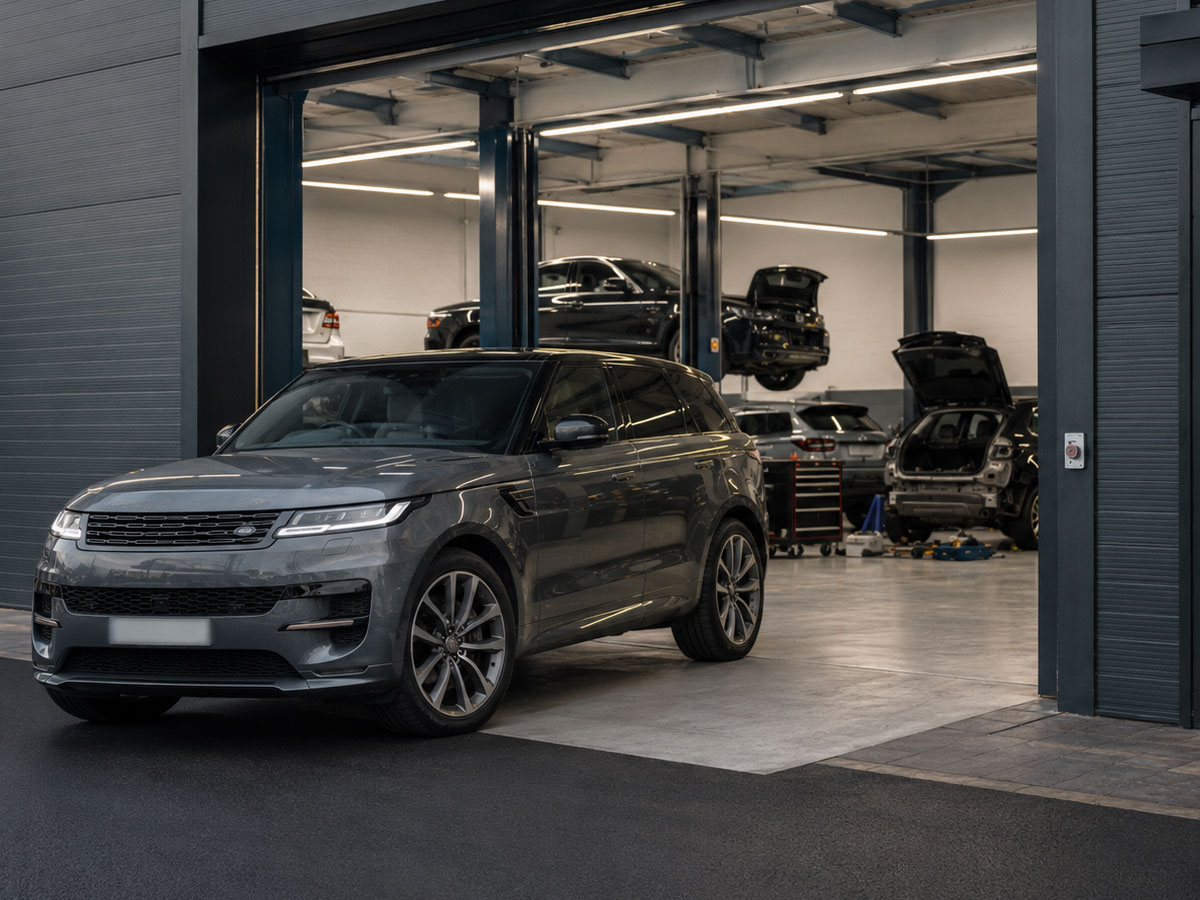
At Crash Specialist Garage, we specialise in prestige vehicle accident repair — and the Range Rover is a vehicle we know well. We carry out the full spectrum of Range Rover repair, from minor panel repairs and complex paint refinishing through to structural work and full multi-panel repairs following serious accidents.
We use genuine Land Rover OEM parts on every repair, carry out proper structural assessment as a matter of course, have the ADAS calibration capability for the Range Rover platform, and operate a dedicated spray booth with the equipment and environmental controls that complex multi-stage finishes demand.
For more information about our Range Rover accident repair services in Macclesfield, visit our specialist service page:
Range Rover Accident Repair in Macclesfield — Crash Specialist Garage
Conclusion
Range Rover repair is not standard bodyshop work. The paint systems are complex, the materials are specialist, the electronics are sophisticated, and the tolerances expected by the owners of these vehicles are correspondingly high. Choosing the right repairer — one with specific experience, the right equipment, and genuine commitment to doing the job properly — makes the difference between a repair that genuinely restores your vehicle and one that falls short.
Don’t let your insurer decide where your Range Rover goes. Exercise your right to choose a specialist who can meet this vehicle’s exacting standards.
Related posts:
- OEM vs Non-OEM Parts: Why It Matters More on Prestige Vehicles
- What Is ADAS Calibration and Why Every Modern Car Needs It After a Collision
- Accident Repair in Macclesfield: What to Look for in a Bodyshop
Frequently Asked Questions
Technically, any bodyshop can attempt a repair — but not every bodyshop has the specialist knowledge, equipment, and parts relationships to carry it out to the standard a Range Rover demands. For a vehicle of this complexity and value, a specialist repairer is strongly recommended.
In the hands of a specialist painter with access to manufacturer spectrophotometer data and the right equipment, a very high-quality match is achievable on most colours. For the most complex multi-stage finishes, including SV Bespoke colours, managing expectations around the limitations of any refinishing is part of an honest pre-repair discussion.
If the repair uses non-OEM parts, it can affect warranty coverage for related components. Using genuine Land Rover parts, supplied through the authorised parts network, protects your warranty position.
It depends on the extent of the damage, parts availability, and the repair scope. A minor single-panel repair may be completed in a few days. A complex multi-panel repair involving structural work, ADAS calibration, and specialist paint refinishing can take two to four weeks or more.
Yes. You have a legal right to choose your own repairer — your insurer cannot compel you to use their network. You should notify your insurer of the incident but you can then direct the vehicle to a specialist of your choice. A good specialist repairer will handle insurer liaison on your behalf.
External sources: