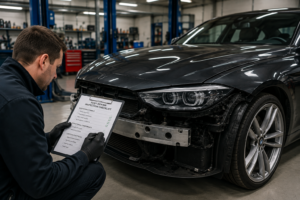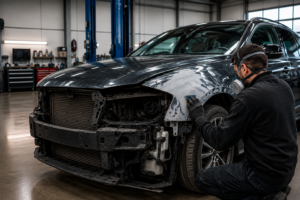

Your car gets hit, the repair is completed to a perfectly good standard, and you assume that’s the end of it. Except it isn’t, not quite. Even a flawless repair leaves a mark that never shows up on the paintwork: an accident history. And that history, once disclosed to a buyer or dealer down the line, quietly knocks money off what your car is worth. That gap between what your car would have fetched with a clean history and what it fetches now is diminution in value, and in the right circumstances, it’s something you can genuinely claim for.
What Diminution in Value Actually Means
Diminution in value describes the drop in your vehicle’s market worth caused purely by having been damaged and repaired, separate from the ordinary wear and depreciation every car experiences over time. Two identical cars, same mileage, same age, sitting side by side on a forecourt, won’t sell for the same price if one carries a recorded accident and the other doesn’t. Buyers factor in the risk of unseen issues, and that discount is the diminution.
It’s worth distinguishing this from Cat S and Cat N write-off markers, which apply when damage crosses a specific structural threshold and get permanently logged against the vehicle’s V5C. Diminution in value can apply even without a formal write-off category, purely because the repair, however well executed, still needs disclosing to any future buyer.
The Case Law Behind Your Right to Claim
This isn’t a grey area insurers can simply dismiss. The principle dates back to Payton v Brooks [1974] RTR 169, a Court of Appeal decision that first established a claimant’s entitlement to recover both the cost of repair and any residual loss in market value. The Court of Appeal revisited and reaffirmed the principle nearly forty years later in Coles & Others v Hetherton & Others [2013], confirming that a reasonable cost of repair calculation can, and often should, include diminution as a recoverable head of loss. You can read more detail on how solicitors apply this precedent in George Ide LLP’s summary of diminution claims.
In plain terms, if someone else caused the accident, the law already recognises that a good repair doesn’t automatically make you whole again, and you’re entitled to pursue the shortfall.
Can You Claim If the Accident Wasn’t Your Fault?
This is the single biggest condition attached to a diminution claim. If you caused the accident, you cannot claim diminution against your own insurer, full stop. Most motor policies explicitly exclude this, since insurers aren’t in the business of compensating you for devaluing your own car through your own fault.
If the other driver was responsible, however, the claim runs against their insurer rather than yours, and this is where the Payton v Brooks principle becomes genuinely useful. You’re not asking your own insurer for a favour, you’re pursuing a recognised head of loss from the party who caused the damage in the first place.
How Much Can You Realistically Expect?
There’s no fixed formula, but practitioners commonly reference a rough scale tied to the vehicle’s age at the time of the accident: up to around 15% of value for significant damage within the first year, tapering to roughly 10% in year two and 5% in year three, with claims becoming much harder to justify beyond that unless the vehicle is a prestige, classic, or otherwise low-volume model. Newer cars simply have more value left to lose, and buyers are far more sensitive to accident history on something that should still look and drive like new.
For retained-salvage vehicles carrying a Cat S or Cat N marker, the discount tends to run considerably higher, often in the range of 15-25% for Cat N and 25-40% for Cat S, reflecting how heavily HPI checks and buyer caution weigh on cars with a permanent salvage flag.
What Evidence You’ll Need to Support a Claim
A diminution claim isn’t self-evident just because an accident happened. You’ll need an independent engineer’s or motor assessor’s report comparing the vehicle’s pre-accident value against its post-repair value, backed by the full repair invoice detailing exactly what work was carried out. The more extensive the repair, structural work, panel replacement on body-coloured components, or airbag module replacement, the stronger the case for a meaningful diminution figure, since these are precisely the details a cautious buyer or trade valuer would flag.
Photographic evidence of the damage before and after repair strengthens the file further, as does a written valuation from an independent dealer or appraiser willing to state what they’d actually offer for the car given its now-disclosed history.
How Long Do You Have to Make a Claim?
Under the general limitation period set out in the Limitation Act 1980, you typically have six years from the date of the accident to bring a claim for this type of loss. That’s a generous window in practice, but the strength of your evidence tends to weaken the longer you leave it, since valuations become harder to pin against the specific accident rather than ordinary market movement.
Why Insurers Push Back So Often
Diminution claims cost insurers money they’d rather not pay, and because the loss only becomes obvious at the point of resale, plenty of drivers never think to raise it at all. Insurers rarely volunteer the option, and some will initially dispute the figure or argue the repair fully restored the car’s value, regardless of what the case law actually says. If your claim is unreasonably refused or delayed, you can escalate the dispute to the Financial Ombudsman Service, which deals with exactly this kind of disagreement between claimants and insurers.
Conclusion
A good repair fixes your car, but it doesn’t erase its history, and that history has a price attached whether or not anyone tells you about it. If someone else caused the accident, the law has recognised your right to recover that loss since 1974, reaffirmed as recently as 2013. The claim depends on solid independent evidence and generally shrinks the older the car gets, but for a relatively new vehicle with a significant repair behind it, it’s a loss well worth pursuing rather than quietly absorbing.
Frequently Asked Questions
Can I claim diminution in value if the accident was my own fault? No. Diminution claims against your own insurer are excluded when you caused the accident. The claim only applies when pursuing the at-fault party’s insurer.
Do I need an independent report, or will my insurer’s own assessment do? You need an independent engineer’s or valuer’s report. Relying solely on figures from the at-fault insurer’s own assessment weakens your position considerably.
Does diminution in value apply to every repaired car? No. Minor cosmetic repairs on older, lower-value cars rarely produce a meaningful diminution figure. It’s most relevant for newer vehicles or those with significant structural or panel work.
How long after the accident can I bring a claim? Generally up to six years under the Limitation Act 1980, though claims are strongest when evidence is gathered soon after the repair is completed.
Is a Cat S or Cat N marker the same thing as diminution in value? No, though they’re related. A salvage marker is a permanent DVLA record affecting resale value on its own, while diminution in value can apply even to repairs that never crossed the salvage threshold.